Praxiteles, or How Famous Can You Get?
Andy Warhol was famous for saying that in the future, everyone would be famous for fifteen minutes. It’s interesting that he’s famous for saying that, but he didn’t say it. Fame is like that sometimes. Fame is like barnacles you pick up on your hull as you pass through the shallow waters of notoriety, into the lakes of celebrity, and finally make it to the sea of fame. It’s unimportant if you “deserve” it. It just is.
Some people transcend their fifteen minutes and turn it into years, decades, and even centuries. How far back can the average person go, and do more than recognize a few names? Go back to 350 BC, and you could trot out Alexander the Great, and be pretty sure of your ground knowing that he wasn’t a haberdasher or a groundskeeper or something. Who else do you know from back then? In general, every century you go back is like drinking six more beers, and then taking the SATs over and over. It gets sketchy, fast:
So ancient Greece is still a thing for some folks, and they can probably at least name Aristotle and Plato, even if they couldn’t pick them out of a police lineup. Demosthenes perhaps, if you mumble or stutter, or if you’re well read. You know Pythagoras, if you’re acute [The management cannot vouch for this pun, and disavows any responsibility for it]. But one name that really gets overlooked is Praxiteles. But he’s got the kind of fame that seems larger than any emperor, really, even if you don’t know his name off the top of your head.
Praxiteles wasn’t a king, a general, or even a philosopher with a toga full of theories. He was a sculptor. Small beer, you might say. Yet his name has outlived empires. Why? Because he dared to do something nobody had done before: he carved a goddess naked. The world gasped, gossiped, and lined up to see it. The statue is gone, but the scandal — and the fame — never wore off. That’s the funny thing about immortality: sometimes it’s built on marble, sometimes on whispers.
The Romans knew who Praxiteles was, and made copies of his statues, so we know what it looked like. Here’s Aphrodite of Knidos, the world’s first static OnlyFans account:
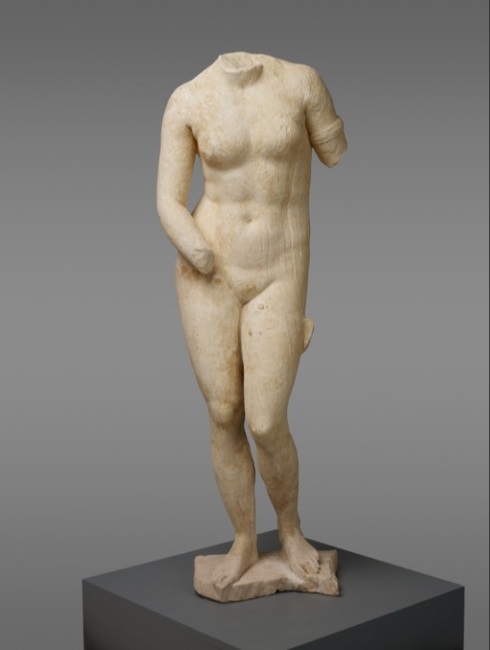
Alas, we’ll never know if she was a butterface, or suffered from man hands, but I suspect not. You see, unlike the Romans, who treated stuff like this like garden gnomes, the reason this was groundbreaking was that while it was a naked chick, it was still supposed to be an object of veneration. It didn’t stop there. The pose is contrapposto. It’s a relaxed, naturalistic pose with one leg bearing weight, with the body twisting slightly. The anatomy is spot on, too. The copies we see are pitted from exposure, but the original was smooth, white marble, and would have looked astounding to a contemporary Mediterranean.
So this approach was kinda lost for a very long time. After Rome fell, the Middle Ages favored more symbolic and less natural-looking cigar store Indians. The Renaissance expanded on the techniques, but was based on an explicit revival of Praxiteles’ approach. Even the painters mimicked the pose:
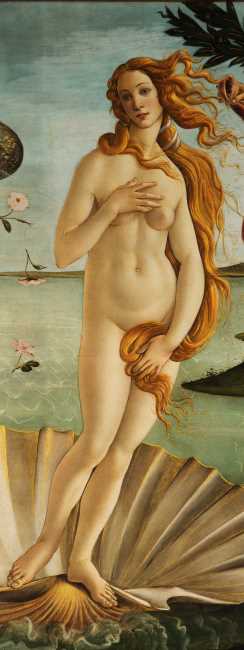
Not just another girl with big feet. Venus is the Roman version of the goddess Aphrodite. To the modern person, The Birth of Venus (1480s) is ancient, but the statue of Aphrodite is about 1800 years older than that.
Fame has never been fair. It doesn’t reward the good or the wise so much as the strivers and the plain bastards. Alexander the Great ran roughshod over half the world, and entered the pantheon of nearly universal notoriety where guys like Elvis and Hitler live. Warhol painted soup cans and made the art world adapt itself to him, instead of the other way around. Social media virality puts afterburners on the fifteen minutes of fame, and usually boils it down to about fifteen seconds on TikTok.
Lots of people these days forgo the only real kind of intergenerational notoriety available to regular humans: having children. We’re all the latest in a line of ancestors who struggled and fought and worked to keep body and soul alive long enough to have a descendant or two. Throwing away that kind of effort for a “career” is absurd. There are only a few thousand people in any generation who have anything like a true career, i.e., a constantly growing necessity for the rest of the human race. What almost everyone has is a mundane job. Admit it, you can’t name Grover Cleveland’s cabinet members, and they were big wheels.
The Irish say that you never die, as long as there’s someone left in the world that speaks your name. As of this date, my father and Praxiteles are still immortal. I doubt I’ll have the staying power of either of them. Then again, I’m OK with that, when I remember that everyone knows who Hitler is.

Recent Comments