We Could Always Motivate Our Employees By Treating Them With Respect And Paying Them Well. Nah

Every once in a great while I get disconsolate about these here Intertunnels. A contest to see who can be the stupidest gets old fast. Nothing much seems genuine. I have every expectation that this video is genuine, don’t get me wrong; but the Intertunnel’s interest in it will not be because it’s good. It’s because it’s very, very, bad.

When you worship the gods of bad and stupid, this sort of thing is what emerges from the tail end of pop culture’s alimentary canal.  Either you’re savvy, and understand that your employees won’t respond to anything serious if it’s presented in a serious way, or you’re a dullard, and think you’re hip because you’re immune to just how lame-o you appear. Either way, you’re not Dale Carnegie.

Or maybe you are. Fish don’t get to swim in the water they desire. They must swim in the water they’re in, or perish. I imagine that it’s deuced difficult to make a living these days selling trinkets to the natives anywhere in the US. There is, literally, not one item in that store that I’d keep if it was given to me. Purchasing anything is out of the question. The owner of the store has to figure out how to get his employees on board with his scheme to sell this dreck or they’ll all starve. His scheme is being pleasant to the customers. That’s it. Nothing fancy. The video will be hooted at much farther and wider than when it was conceptualized, that’s for sure, but the point was made, moronically, perhaps, but no one that watches it would be struck by the idea that there were unpleasant people anywhere near it. Many nice people don’t summer in Cannes, and dress in couture. I said nice people, not Nice people.

If you had produced the best customer service video ever made, flashy and full of sober and sage advice to the retail worker, you’d get maybe five thousand hits on YouTube. I guarantee this one will get five million. Therein lies a lesson. My only problem is I have no idea what that lesson might be.

Kids These Days

If you’re of a mind to lament the comparative worthlessness of kids these days, there’s one detail about your observation that I’m certain you’re overlooking: Kids don’t make themselves.

Children have almost no autonomy. They are what we make them, almost exclusively. We have the greatest effect on our own kids, but we have some effect, at least collectively, on all of them. That may sound weird to people who know me. I don’t believe in “collective guilt.” But people who do believe in collective guilt are guilty as hell when they say, kids these days. The index finger points out two malefactors, generally.

Kids these days are probably tired of hearing that they grew up in the world others made for them, but they’re somehow doing it wrong. I’m not young anymore, but more than once I’ve suffered an affront that goes something like this: You screwed up; you cooperated. That’ll teach you!

Well, I don’t cooperate all that much anymore. I’ll tell old people to get off my lawn, mostly, but not the young people. I like energy and the promise of better things to come. I will continue to do so until I get a bed with a lid.

I like my own kids, and every once in a while I indulge my wife and allow myself a bit of pride about their energy, or their bearing, or their good natures. I would expect to be judged harshly if they had turned out like… kids these days.

My reason for refusing to sanction the bylaw made by the borough
council of Stoke Newington was that I have received no evidence that
the dangers arising from roller-skating by boys and girls are so much
greater than the ordinary dangers of traffic in the streets,
particularly motor traffic, that the practice ought to be prohibited by
by-law.  Such a by-law would create a new offence punishable by the
criminal law…would lead to the imposition of fines, and possibly to
the detention and imprisonment of children and young persons for
indulging in a form of amusement which would be legal on one side of
the road and illegal on the other. I am very reluctant to increase the
number of occasions when the children of the poorer classes may be
brought into the police-court and rendered liable to imprisonment”
.   -Winston Churchill

Since I Met You, Baby

Eric Lindell, with Anson Funderburgh on guitar, resurrect Elvin Bishop’s Fooled Around And Fell In Love from 1975

It’s completely lacking bellbottoms and dusters, or carpenter overalls with one strap worn over the shoulder. No sign of turd curls. No plaid pants that I noticed. Anson’s flirting with a Qiana shirt there, but the collar’s too small. Gotta flap in the breeze like Sister Bertrille’s cornette to be a real Qiana shirt. There isn’t a decent Jewfro in the place. No one’s got a necktie wide enough to use as a tablecloth, either. Nary a tube-top to be seen.

It’s like their heart really isn’t in it.

El Jefe

[The end of a saga. I was a welder in the desert back in the day. I’ve been trying to explain how I got into that predicament without sounding stupid. It’s not working]

The tribe wasn’t talking, at least not to me, and not in English when I was nearby. Larry the foreman wasn’t interested in holding my hand. His hands were full of index cards with pencil runes scrawled on them. Hitler’s stunt double, and Irwin Corey’s red-headed nosemining love-child, seemed of doubtful utility. The girl from Flashdance wasn’t going to show up anytime soon and show me how to weld between dance numbers. I was going to have to, as Peachy Carnehan says, “brass it out.”

Nowadays, dorks on the Internet enjoy playing the The Dunning-Kruger card in blog comments at 3 AM to try to settle things, but the concept isn’t useful out in the real world. It wasn’t a useful thing to know before the Internet, either. Everyone in the Dunning-Kruger experiment was a college kid — i.e., someone full of themselves for no reason. Saying that stupid people think they’re smart, and smart people think they’re stupid, is simply a way for people with an IQ of 105 to attempt to sidle up to people forty points north of that and say, “Isn’t that guy with an IQ of 103 a dolt?”

The people educated people think are really stupid — people with dirt under their fingernails –don’t “think” they’re smart. They are smart in the only way that matters. They know what they’re about. They don’t go on Jeopardy and expect loading dock questions. Conversely, if you’re a welder and can’t weld, your enthusiasm for French poetry or something equally useless wouldn’t enter into it. So I might have been the smartest person to ever enter the zip code I was in, but I most certainly was the dumbest fool in the room. There’s only one way to keep score. Style points can’t weld things. So I hitched up my britches, got in line at each work station, and when in Rome…

I did as the Romans did. Badly. I couldn’t pass for Roman, but I could have at least ridden the short bus to an Etruscan elementary school after a while. At first I couldn’t get the electrode to spark, then I welded it to the brass fixture. I used ten pieces of filler rod to everyone else’s one. My work had more bubbles in it than a frappe, and was more lopsided than an election in a dictatorship, but I stuck with it. I drove home every afternoon in a trance, then slept in my dirty clothes on top of my bedclothes until the next morning. That’s when I discovered that a little help would have gone a long way.  I woke up on fire. And not the good kind of fire that can be extinguished, either. The sensation was the same, though. I went to the bathroom and pulled off my shirt.

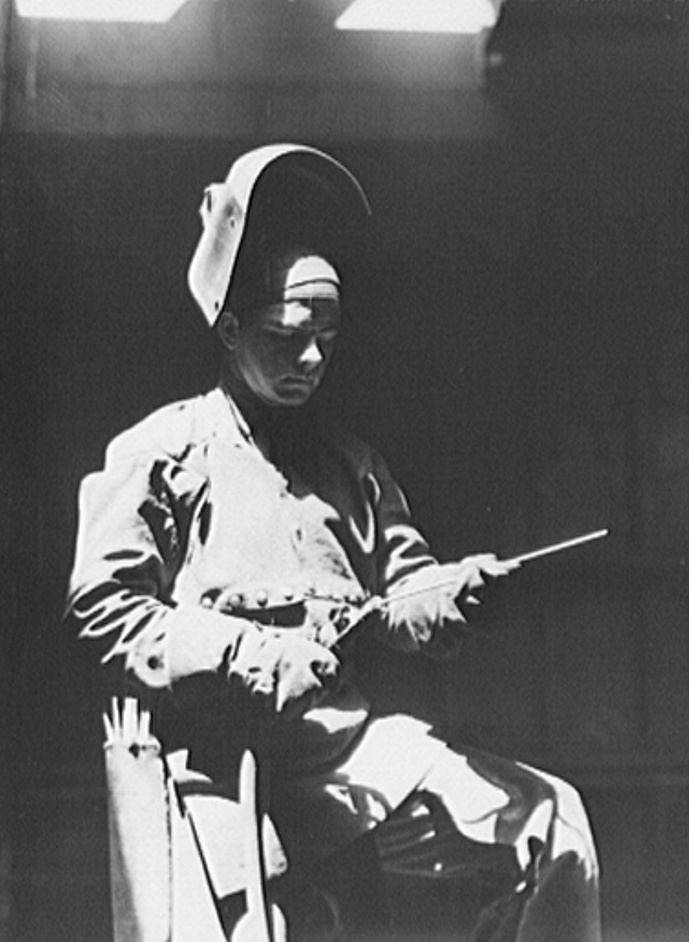
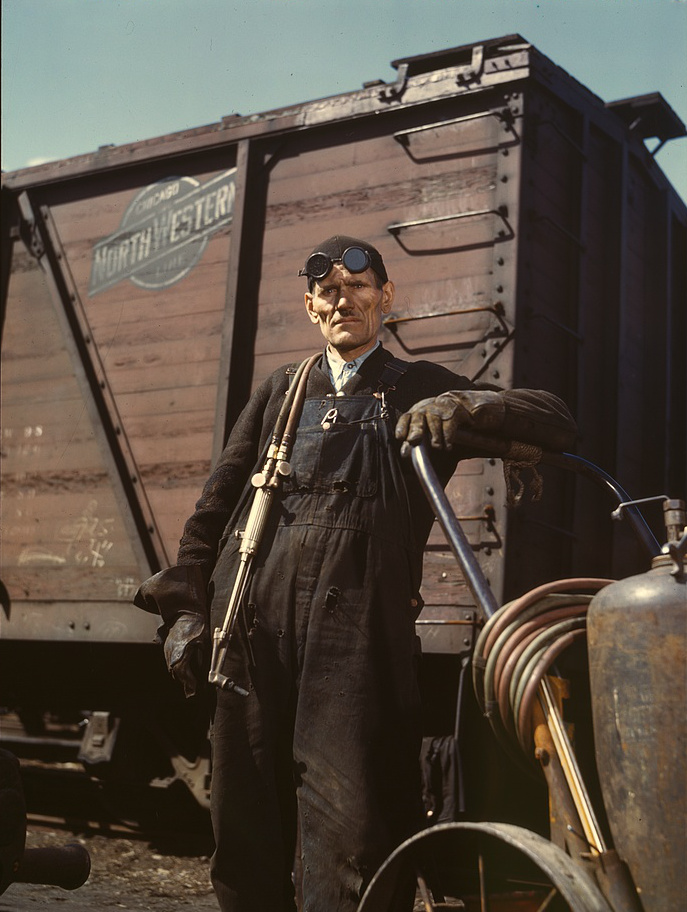
I’d worn a long sleeve shirt — cotton; even I knew that any sort of polyester version would ignite if welding sparks hit it, cotton just smolders —  a welding helmet, and leather gauntlets. But I didn’t know enough to button my shirt all the way to the top. I’d left a triangle of flesh exposed to the ultraviolet rays that welding likes to bless you with without you noticing, and I’d burned a big Bass Ale logo onto my chest. It hurt like taxation, with the lemon juice of sheepishness ladled on it. I buttoned my shirt over my own personal superman logo, and slowly abraded it off over the next couple of weeks. I swear I can still make out its outline all these years later, whenever I’m shaving that fool’s face in the bathroom mirror.

Day in, day out, I hung in there, no more than that, and no one talked to me in any meaningful way. Amish couldn’t have shunned me more effectively. At lunchtime I sat alone and ate my pasty sandwich at my shabby desk while the easy laughter of the other men drifted in through the open door as they stood out in the blazing sun and ate burritos from the “roach coach” that pulled into the lot every day at lunchtime. I slowly morphed from a gibbering Irishman into one of those fellows that lives in a barrel and eats thistles and drinks from puddles and waits for wise men that never show up.

Like all places with a rough and tumble workforce, everything worth a farthing was locked in a big cage, which was lorded over by a human guard dog. There was a very calm and quiet young fellow in charge of the place. He was a short Messcan. There were tall, lordly Messcans about, too; they looked like Andalusian Senators or something. But he looked like Mexico before the Europeans showed up. He was dark and doe-eyed and taciturn, and had been trying to grow a moustache unsuccessfully since he was born. He sat at the neatest desk in the building, knew the protocol for everything without hesitation, and spent most of his time reading. He was not required to do anything except hand us stuff, and keep track of it all. All of a sudden, I was informed that he’d been keeping track of me, too.

“Do you know why they don’t like you?”

I briefly considered feigning ignorance of this Everest of quiet contempt I’d scrambled up and down every day, but I thought the better of it and just said, “No.” Which was the truth.

“They don’t like you because you took their cousins’ job. Their brothers’. Maybe their fathers’. Who do you think all those cholos in the lobby were when you came in here? They need to weld. You don’t need to weld. You don’t even know how to weld. You could do what you like. You took someone’s place.”

I was sort of stunned. I’d been in unions that cared less about whether you were part of their brotherhood. 

“They would have gotten over that, I guess, eventually, but they know that you hate messcans, man.”

“Whoa, whoa, whoa. Who says I hate Mexicans?”

“You think we all steal.”

“What the fuck are you talking about?”

“Every day you bring all your tools home. We see it. Every day. You think we’re all thieves.”

There was a long pause while I processed this information. I imagine I had a look of wonder and astonishment on my face that wouldn’t be equaled until much later in my life, when another, smaller version of me appeared, coming out of my wife.  That would be quite a long time, as she was currently in ninth grade.

“Do you really think that if I could do something else — skin diver for Roto-Rooter, rottweiler dentist, anything —  that I’d be a welder in the desert? You must be crazier than I am. And let’s get one more thing straight. I bring my tools home every night because every single goddamn day I figure today is the day that I can’t take another minute of this godforsaken filthy oven, and I’m never coming back here. Every day I bring my tools home because I might need something fairly sharp to kill myself with when I get home. If I thought you’d steal my tools, I’d have left them here and prayed you’d steal them, if it meant one less day working in this dungeon.”

The next day, they came in a gang, and dragged me bodily out into the late morning sun, the parking lot shimmering with the heat like a cookie tin from the oven, and they hugged me and bought me burritos from the roach coach, so spicy that they made me shiver, and after work they hauled me all over their town and got me drunker than a fiddler’s whore, and the next morning I threw up chicken mole and Tecate in the john, and the man in the cage said, “Now you’re one of us, jefe.”
Steal With Your Eyes

[If you just came in, I was a welder in the desert back in the day. I’ve been trying to explain how I got into that predicament without sounding stupid. It’s not working]

You can bluff your way through most any circumstances if you’ll simply pay attention. “Steal with your eyes,” it was once explained to me. But paying attention to what? That’s the big question. First day on the job, first date, whatever. What do you pay attention to, and to whom? Who’s a sage, and who’s a doofus? I swear this is the only kind of wisdom you can pick up in this world. You tune out one thing after another, one philosophy followed by another, stop reading bad books, stop wasting your time caring what flavor of imbecilic pop songs comes out of someone else’s radio. To live in this world is to be an editor, not a writer.

So I’d promised them I was a welder, and I needed to be a welder, and I was determined to be a welder right quick. I looked around furtively early on, and tried to espy anyone giving off a Stakhanovite vibe, determined to shadow them to see what’s what. Grand Theft Eyeball.

In these situations, it’s my experience — hard-won — that the first person from any insular group that tries to strike up a friendship with you, the new guy, is invariably either a ne’er-do-well or an incompetent. Usually both. Everyone else in the building already knows of, and is tired of, his schtick, so he tries it on the new guy. You can generally learn how to get fired, immediately, from this person.

But I was young then, and didn’t have this sort of information in my head yet. I was a lamb for any stray coyote to get ahold of. I’d be friendly with anyone that would be friendly back. This place presented a problem. No one was friendly. No one even looked at me, except to glare, and precious little of even that. I immediately got the impression I was a seal on an ice floe with a dozen polar bears, and the bears did nothing but whisper to each other, then look over their shoulder at me from time to time. I didn’t get the impression they were planning a surprise party for me. My attitude toward them didn’t matter, so I relied on my grade school education to see me through. Who was the nun in the room? They’ll have to talk to me. Larry, the happy Hawaiian with the fantastic aureole of frizz around his head, was the nun. He was in charge. He’d have to help me, surely.

This simply presented another problem. Larry was sort of silly. He smiled all the time. He smiled when things went badly. He smiled when things went well. He smiled while he was being devoured by crocodiles. OK, OK, but he would have, I’m sure of it. If you asked him a question past where’s the john you flummoxed him. He smiled when he was flummoxed, especially.

But it was me, of course, that was truly flummoxed, not Larry. Larry wasn’t going to be fired if I couldn’t weld. Larry would smile and wave to me in the same way if I was run out of the town on a rail, or picked up by limousine to go get my Nobel Prize. I was in a strange place among strange men, doing a strange thing. They all belonged there. I didn’t. But I had to. My back was against the wall and the cigarette was almost out.

There was a work room separate from the big shop area. Everybody got a metal desk that looked like reform school, where you could solder things, or eat your lunch, or solder your lunch, or eat solder, or do any number of other interesting things. Larry pointed out mine, towards the back. I sat down and looked around. To my left was a voluntarily mentally retarded young man with Professor Irwin Corey’s hairdo, thick glasses with bent frames, and skin like the Sea of Tranquility. I tried watching him, first. I watched him mine his nose, and add the contents to his diet. I did not get the feeling that he was reading encyclopedias at home by the hour for amusement. My eye wandered on.

In front of me there was what appeared to me to be an immensely old man, probably four years younger than I am now, with a bucket-shaped head, a haircut that was obviously the denouement of some sort of bet he’d lost, and a moustache that had gone grey mostly on the sides, so that only the portion of his cookie-duster directly below his philtrum was black, and so rendered him the spitting image of the former chancellor of the Third Reich. He was repeating the same non-joke over and over to no one, just out into the ether. He thought it was funny to hold up a can of Glyptol, a kind of sealer paint, and pronounced it “Griptol,” in a Charlie Chan accent. My eye wandered on.

Everyone else was, in the charming vernacular they all used, “Messcan.” They were a tribe and a family and an army. I could see immediately that in any real sense of the word, they owned the place. And they were inscrutable to me.

[To be continued, if you feel like it]

Month: September 2013

Find Stuff:

Archives