Reader, commenter, and dare I say friend, Shoreacres purchased one of my Evangeline Tables today, (Many thanks to everyone that did!) and supplied a link to one of her essays that also touched on the poem Evangeline. She wrote it a few years back, but Longfellow never goes stale. It’s eleventy times more interesting than my essay, and there’s good music in the comments, too. Go!
BERLIN – Swedish furniture giant Ikea expressed regret Friday that it benefited from the use of forced prison labor by some of its suppliers in communist East Germany more than two decades ago. The company released an independent report showing that East German prisoners, among them many political dissidents, were involved in the manufacture of goods that were supplied to Ikea 25 to 30 years ago. The report concluded that Ikea managers were aware of the possibility that prisoners would be used in the manufacture of its products and took some measures to prevent this, but they were insufficient. “We deeply regret that this could happen,” said Jeanette Skjelmose, an Ikea manager.
Sippican Cottage today released a statement expressing remorse for the use of forced labor in his factory, and promised to do better in the future.
“I deeply regret forcing the sole employee of Sippican Cottage to work up to sixteen hours a day, seven days a week, for no paycheck, for the last eight years,” said Mr. Cottage, the sole employee of Sippican Cottage, “and I have no idea what I was thinking not taking a vacation since 1998, either; I should be ashamed of myself.”
Mr. Cottage said the near-slave conditions he kept himself in seemed necessary at the time, but he realizes in hindsight he should have just given a state senator an envelope full of twenties and gotten a block grant or something, and been at the pub at noon on Friday like everyone else. He admits he was just being unreasonable. “I kept trying to pay my property tax bill in full, instead of giving an easement to the conservation committee for the four acres of swamp in the back to get an abatement, and it just sort of spiraled from there. Pretty soon I was forcing the only employee I’ve got to work for four hours on Christmas Day to make enough to pay the excise tax on my rattletrap truck before the interest started piling up like last year. Jeez, I’m a bastard.”
Mr. Cottage describes a slippery slope confronted by many businessmen: when does the desire for profit trump simple human decency? For Mr. Cottage, the answer was simple. “You’d think I’d have learned after my wife had the first kid, but somehow or another your mind gets fuzzy from listening to the dull bandsaw blade screeching in a case-hardened piece of wood all day, and you sorta drift off to the dark side a little at a time. Like an idiot you think that once a kid’s big enough, you won’t need four hundred dollars a week for Enfamil and diapers, and maybe you can let the only employee sleep until after sunrise on Saturday once in a while. But no; then the little bastards start eating real food, like, twice a day or something, and it’s right back to Solzhinitzyn-grade time management in the shop.”
Further digging reveals Mr. Cottage’s seemingly contrite attitude towards his former transgressions masks an even darker secret. Not only did he make his only employee work in near darkness in a nasty windowless basement for almost five years straight without a break, it turns out that the employee was disabled as well, a fact that Mr. Cottage hid from both the authorities that could have helped, and from his family as well.
“OK, you got me. My only employee is north of fifty now, has had a bad back since the 1970s, Meniere’s Syndrome, bad eyesight, tinnitus that sounds like four guys with Tourette’s throwing junk cars down a mineshaft, a terrible inflammation of his plantar fascia that’s morphing into arthritis, a bad knee from a car accident thirty years ago, and even though he’s allergic to bee stings, I made him go up on the roof and reshingle it last summer. But in my defense, none of that stuff seemed like much, compared to all the really disabled people I see getting help for their ailments. Until you’ve looked into the eyes of someone that’s prone to panic attacks, or that’s had someone look at them funny at work once, or needs a miniature service horse to shop at Whole Foods, you don’t know how lucky you are. I told him, er, me, to suck it up and get back to the table saw.”
Although he’s promised to do better, Mr. Cottage says he — and his Schedule C –can’t help thinking he’s leaving money on the table if he starts taking his foot off the face of the fellow in the shop.
“I mean, I know guys that are forced to limp during an entire round of golf in case an insurance adjuster is surveilling them at the course. I really didn’t think I’d have the kind of mental toughness to persevere under that kind of tyranny. Imagine trying to remember which foot to limp with all the time! So I admit it; I just took the easy way out, and just yelled at the help to work harder. Luckily the saws drown out the yelling so my wife doesn’t hear me upstairs. I don’t want her thinking I’m crazy or anything.”
When I was little, I went to parochial school. I don’t think they call them that any more. The nuns were very kind — still dressed in full penguin togs and fingering their beads by the hour. They read to us. We read Longfellow. Evangeline
Ye who believe in affection that hopes, and endures, and is patient,
Ye who believe in the beauty and strength of woman’s devotion,
List to the mournful tradition still sung by the pines of the forest;
List to a Tale of Love in Acadie, home of the happy.
Longfellow was from Maine, and lived in the first brick house in Portland. The whole town is brick now. It’s a fitting metaphor for his life. He was one of those people whose work was so accessible and popular that eventually no one wanted it any more. It can’t be any good — everyone likes it. I still like it.
I don’t create things as much as I’d like. I make things, which is honorable, and gratifying, but it is not always the “whole” thing –the process from soup to nuts, concept to sticks and bricks. I wanted to make the whole thing for a change.
I had this raw material. I’d purchased a pile of flame birch many years ago. It’s the king of all American woods, if you ask me. Hard as a banker’s heart, and beautiful as a girl that won’t talk to you. I tucked it away to do something with it — eventually. Eventually is a terrible word in my life now. There was potential in the rough planks of wood that could be brought to bear for the right project. But what?
Creation is the whole thing, as I said. I set up my lathe again. I like the lathe. It’s quiet. I don’t have to put a vise on my head to use it. It’s not a rote operation, ever, even when making the same leg over again. My little son said, “Daddy is sculpting again.” I adored that. I was. But more, I was thinking. I was trying. I was striving to make something, the whole thing.
What to do with flame birch? Shakers used it once in a while. But I was not thinking spartan. The wood is the hardest stuff America produces. I was thinking of the forests from whence it came. I was thinking of Acadie. And so I thought of Longfellow, and Evangeline.
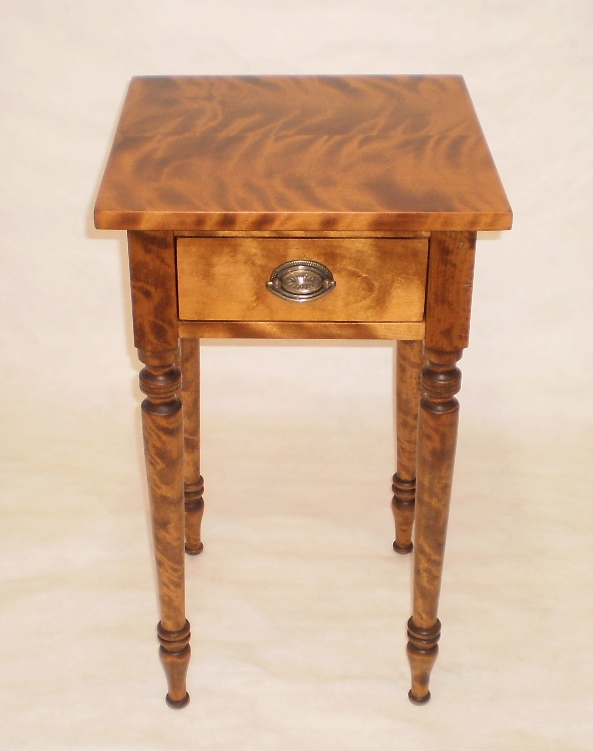
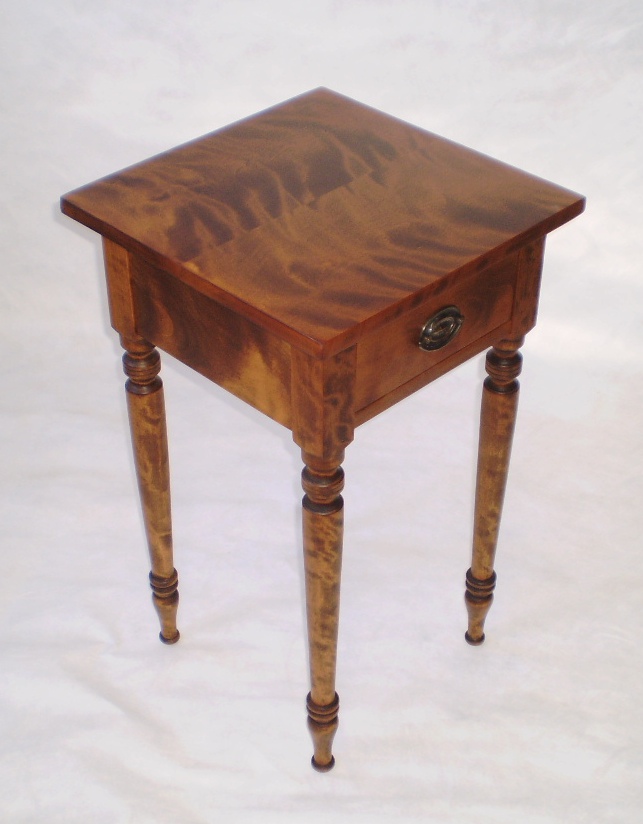
It was going to be a nineteenth century table, the legs would have tulips for their toes, and the wild, iridescent grain would be revealed, but somehow tamed by the soft shapes of the turnings. The heaviness of the forest would be transformed into something sophisticated and delicate. I went back and forth over dimensions, proportions. I made it small enough to seem delicate, but big enough to be elegant and useful. I think I made it beautiful, but that is not for me to say.
There is a statue of Evangeline in Nova Scotia. It is where my father’s family came from, and the statue was made by a sculptor who used the actress my mother is named for as a model. So I had this whole idea, a mishmash brought together into an object.
The table has a look of unreality to it. The grain flips from dark to light when you walk past it. It becomes a negative of itself and then goes back again as you move. It’s like tortoiseshell. I made it for my Father, who is gone, and my Mother, who I do not see often enough, and for Acadie, and for the nuns that read Evangeline to me.
I cannot keep it because there’s nothing wrong with it. We can only keep the things that aren’t right somehow. You can buy it. It’s not on my furniture website right now, so my readers can see it first, here. This table is either the first one, or the only one; I’m not sure which yet. But I must put it out in the world because it’s the best thing I’ve done, and there is no eventually for me any more.
$399.00, Ready to ship. Free shipping to anywhere in the lower 48 states. 16″ x 16″ x 27″ high.
[UPDATE: Sold to Bob in Missouri. Why do I have so many friends in Missouri? I don’t know, but I’m glad of it. Thanks, Bob]
[Saturday Update: Due to the overwhelming interest in this item, I’ve decided to accept orders for Evangeline Tables here on my blog. They’ll be ready for shipment approximately six weeks after you place your order. Many thanks to all my friends for their kind words and their interest in Sippican Cottage. Still $399 each, free shipping included]
I like squares. I think I’m a square, although that’s not for me to say. It must be said about you. I think squares accomplish most everything notable in the world. The hipsters crib from the work the squares do, to achieve their ill-deserved notoriety. The squares invent the moldboard plow, turn the earth deeply, and feed the world with their crops. The hipsters later keep windowboxes full of plastic flowers. No one will remember Lady Gaga in a hundred years. My grandchildren will play Dave Brubeck records.
All my favorite people are squares, and in the arts, too. Dave Brubeck was L7, man. Yeats was the last man picked for dodgeball, writing poems about the first girl he ever kissed until the day he keeled over. Pelham Grenville Wodehouse was a joiner. Mark Twain was the mayor of Squaresville.
Dave went to school to be a veterinarian, and his teacher told him to go across the hall to the music room because that’s where he belonged. He couldn’t read music, so they gave him his diploma with the stipulation that he never teach music — because that’s what a music school is there to produce: music school teachers. Dave thought it was to produce musicians. What a dork.
What would you do if you were a pianist, fresh out of school? You’d smoke French cigarettes that smell like ass and affect some sort of accent and wear a beret and drink wine outa bottles in a basket and so forth. Dave joined Patton’s Third Army. That’s what squares do — what needs doing. They figured out he was more valuable playing the piano to the Mauser fodder than being the Mauser fodder, and he toured around cheering people up.
Then he got out and started a jazz band, and did what squares do. He treated everyone as an individual, and had an integrated band, and he worked hard. He found a place to play, and he played there, and he collected his money, and kept working at what he was doing, befriending more people that could help him. Then he got real square.
I want you to picture yourself in a record company meeting. A guy that looks like he flunked out of veterinary school, but kept the wardrobe, comes in and says he’d like to make a jazz album. Jazz albums don’t sell of course, but this dweeb, looking at you through glasses like the windows on a submarine, doubles down and says the whole album is based around playing in limb-contorting, ear-disorienting odd meters like 5/4 and 9/8. You could tap your foot to Blue Rondo a la Turk if you’re a carnival sideshow geek, and have the extra limbs required, but for accessibility, that’s about it. The rest of the record is wheelchair accessible for dancing after two martinis at the Copa, maybe.
So you’re the A&R man. You just put out a Johnny Mathis record, maybe a Fabian single, or maybe you’re tragically hip, and you’re eating lunch with an Ertegun and you’re pressing a Sarah Vaughn disc in the afternoon. What do you say to Ichabod Brubeck? Admit, it, you’d ring the buzzer and have him walking spanish to the curb courtesy of security. You’d have no way of knowing that Dave’s record would be the first jazz album to sell a million copies. Only squares understand what squares are doing. Eventually the beautiful people get on the horn and yell at their underlings, “Get me one of those Barbell.. er.. Burdick… ah, whatever that goofy bastards that can’t count to four are called. Brubeck. Yeah, that’s it. Find me one of those. Them. Whatever”
I don’t know why the world makes the squares perform their very square dance alone for a while while we titter at them. You’re all going to dance to it sooner or later.


Recent Comments