John Fredrick’s Son (From 2007)
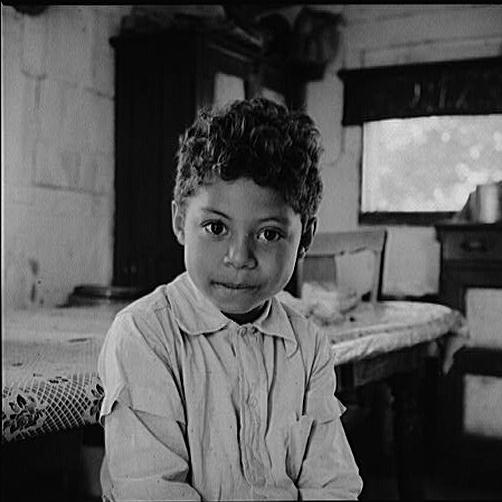
I found this picture in the Library of Congress. The caption is what caught my eye at first, although of course the picture itself is very compelling. The caption reads:
John Fredrick’s son: “Some day we’re goin’ ta have a new house too, an a car like you all.” Saint Mary’s County, Maryland
The picture was taken in 1941. That is a very moving, mundane thing to read. That boy’s father is outside the shack with people helping him to dig a new privy hole and drill a new well far enough apart so that one does not foul the other.
People used to instinctively understand that owning a house that could become a home could in turn could become a catalyst for, or a safeguard of, the only really important institution devised by man: The family.
People often assume I am consumed with nostalgia and am backward looking. I don’t think so. I see people retreating towards barbarism and calling themselves progressive. That’s all. In a very real way, I am living right at the edge of what society and technology allows. And I like it here.
I see the idea of a home that has meaning in and of itself slipping away at all price points. It’s just a rubber box to sleep in and hold the satellite dish for an increasing number of people, and I find that disturbing for cultural reasons as much as aesthetic ones. I hear of people who pay their credit cards and abandon their homes because the homes hold no equity and hence have no intrinsic value, but their credit cards are valuable. But my home, and the home of many others who share my worldview, if perhaps only subconsciously, have intrinsic value that stand alone outside of commerce. It would be a big deal for me to lose my home. It’s not just a box I live in.
That little boy in the picture understood that the way he understood the stove is hot. He did not require a white paper referencing Le Corbusier, Bruno Zevi, Christopher Alexander and Martin Luther King to figure it out.
He knew about the car, too. People used to understand viscerally what it meant, what it really represented. Even a serf knew when he was no longer tied to the land, unable to leave. You are free to go if you must, or you will– but especially if you can.
The desire and ability to stay in one place backed up with the freedom to go if you so desire, or must. The vast majority of us take all of that for granted; or worse, a very vocal minority are actively opposed to it for reasons that boil down to, in a dark unguarded moment: I’ve already got mine, to hell with the rabble.
Resist the assault on all of it, lest your children find themselves in a hellish shack, wishing they had it all back.
I hope you got them, John Fredrick’s son.

Recent Comments