Where Do You Take Your Children?

There’s a fetish for hating children afoot.

That’s not an exaggeration. If you want an opinion about children in restaurants, on airplanes, in movie theaters, pretty much any public place, scout the internet, and bring smelling salts. And don’t bring more than one child, or you’ll be reminded it’s a not a clown car, lady.

The problem- and there is one- is not the children. It’s the adults. I meant to type: “adults,” with the quotation fingers going. There aren’t any real adults involved.

There are two kinds of “adults” involved. One is the parents of children who do not know how to behave themselves in public, and the other is anyone that doesn’t want to see a kid anywhere they go.

The second group is easy to place on the couch and figure out. They’re jealous that they have to act adult -a little- and a kid gets a pass. They are like little children themselves, just bigger and pushier and equipped with credit cards. They have no better interpersonal skills than the hellion in the back seat on a long car ride, and can’t stand to see anybody doing anything that they can’t do. Real adults who see children misbehave in public places feel sorry for the children, not themselves.

The first group is just the second group, only they have their own children. And they have never bothered to teach their children how to behave in public, because they don’t know how themselves. They’re afraid to teach or enforce any standards of decorum for their children, as they know that means they’ll be expected to adhere to them as well. We’re all just big children living together in a house, undifferentiated, now, aren’t we? I’m not foregoing R rated entertainment just because my kid’s in the room. It’s much easier to call anybody who calls for any standard of decorum a Nazi and do whatever I want.

When I was small, my parents brought me places. Serious places. We didn’t all go to Disneyland in flip-flops and tatty t-shirts. We went to museums. We went to Mount Vernon. We went to the library three times a week. We went to Plimouth Plantation. Serious places like that. Many of them had a profound and life-long effect on me.

Don’t get me wrong. We went to the ball game and threw peanut shells on the deck like everybody else, too, and things of that nature. And I’m not dumb enough not to understand that part of the allure of those serious places was undoubtedly that many of them were cheap -or free. But the very first things we learned were how to behave in public. And we were taught how to be polite and deferential towards others, especially adults. We didn’t go to the Newport Mansions and jump on the beds. The idea of being polite and deferential to your parents is quaint now, apparently. Paying any attention to or displaying manners of any kind whatsoever to adult strangers is now a bizarro-world concept.

I brought my four-year-old to the Marble House in Newport once. The docent took one look at him and grabbed me by the arm and whispered: “Are you sure this is appropriate for him?” What they really meant was that it was assumed he wouldn’t know how to behave himself, and so, well, beat it.

Why don’t you ask him yourself? I said.

Do you want to go in the nice museum? You must be very quiet and not touch anything, okay?

His clothes were clean and not spangled with semi-scatological slogans or cartoon mice, and his finger was not in his nose. He stood up straight, looked her full in the face and politely said: “I’d like to see your museum and I know how to behave.” In faultless diction. That was the end of the questions.

I found a pamphlet I had saved from the 1960s from a visit to Mount Vernon. I leafed through it, and I remember everything about that place. We were not wealthy people, and I can only imagine what it cost my parents to manage that excursion. As I said, we were poor, and I was young, but I can’t imagine my parents were ashamed of me. I know I wasn’t ashamed of them.

(The picture is Athena protecting the muses of Architecture, Painting, and Sculpture by John Singer Sargent in the magnificent Museum of Fine Arts in Boston Mass. My parents brought me there when Johnson was president.)

Update: Pat at Stubborn Facts has some additional thoughts on the matter, with many interesting comments here.
Planting Season

We have a tradition here at the Sippican Cottage. And the tradition has been born and tweaked and upheld for over a decade now, and has offered me a perspective on what tradition really means, if only in a small way.

Neither my wife or I had any idea what to do in a garden when we were first presented with the miserable patch of ground outside our exurban door. Our childhood experience was suburban, but our families, like most suburban families of the last generation, were essentially of the urban mindset, if not location. They moved from third floor walkups to suburban ranches, but there was more than a little bit of the rented flat about them forever.

My own father was not a gardener, by any stretch. He mowed the patches of wan green in between the vast stretches of brown on our lawn like a good citizen, but that’s as far as it went. He always had the air about him of a man who should have a newspaper and a pot of tea on a table surrounded by cobblestones — he’s no farmer.

My mother is much more adept in the garden, but I got none of it. There was always something of the urban in her gardening too; more windowbox gaudy than sedate pastoral charm. I was of no use to her as a child, and only learned the simplest things about planting: mix dung and peat in the hole and water it. It was enough, in a way.

I read a lot of gardening books. Some were very serious. You can tell a serious gardening book; it doesn’t have any pictures.

The mass of books I looked at, the ones with nothing but pictures, had the whiff of the fast food restaurant to them. The old advice: “If the menu has pictures of the food on it, it’s not likely to be haute cuisine” applies to gardening as well.

There’s a kind of cognitive dissonance to most gardening in the suburbs, because the whole layout of the houses and the surroundings is flawed, generally, and the visual confusion it engenders leads to a kind of Home Depot delirium tremens in landscape design as well. The home might be put on a kind of country manor house lot, but looks like an urban design, or a home that belongs in a desert is stuck in a jungle, and so forth. Fill in your own stucco nightmare here. A sort of incoherence seeps into the proceedings, garden included.

We’ve murdered enough plants to get Gaia knocking on our door with a mob of woodland nymphs with pitchforks and torchs, while we tried to figure out what to do, where. But while we are not born wise, we learn — if haltingly — what works, and what looks appropriate, and what helps to blur the distinction between in and out, and porch and lawn, and lawn and woods, and woods and world. Just between you and me, the books without the pictures help some, but the beating the world gives you trying desperately to grow things is the real education. I’d skip the Feng Shui picture books altogether, if I were you.

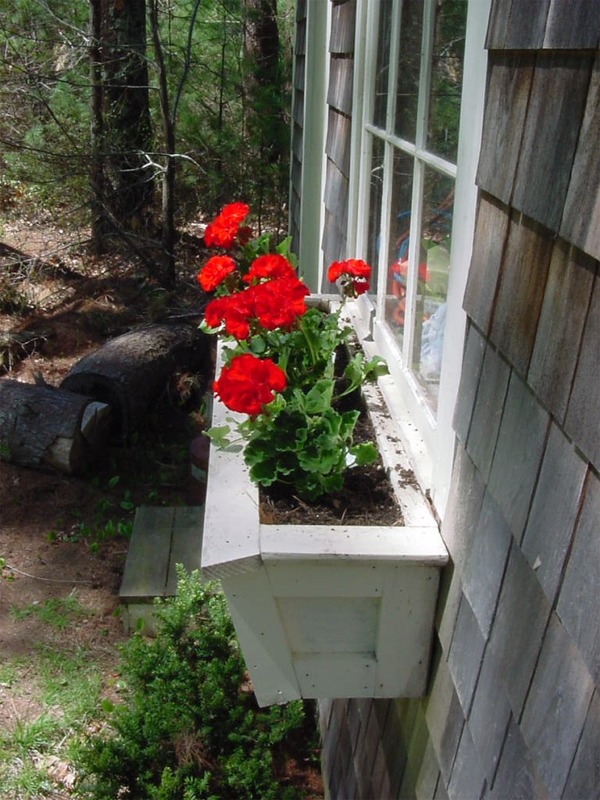
So every year, we put the geraniums in the pots on the front step, and in the window box on the shed, with some vinca vine to trail down and wave hello in the breeze a bit. We divide the hostas and put them around the yard, in the shade, here and there. We tend to the rhododendrons and barberrys we had the presence of mind to plant in the right place a decade ago, getting dividends we earned the hard way which almost banish the cruel thoughts of all those shrubs that did not survive an immediate razoring to the ground by hungry deer. We mow the grass in gentle curves, as nature intended, not laid out as if by laser like a farm plot. We hang a few dipladenias outside windows we want hummingbirds to favor, and we steal the tall phloxes’ freeseeded progeny and the bottomless well of pachysandra one plant provides, and we know it will work, and we know how to work it. We caress the lamb’s ear to remind it to carry on. We leave great swaths of our property wild, and only clean out the buffer between, a little, to provide the transition.

Tradition is a kind of faith; you trust it will work because you trust it will work. I bet many traditions, like ours, are born every day. Sometimes you wish that someone could have told you what to do, instead of having to figure it out yourself; but would you have listened anyway, if the book did not have pictures?

You Could Put Your CD Jewel Cases In Them, I Suppose

I’ve made a hearty handful of China closets. Some freestanding, some built in. It’s a fascinating bit of architecture.

People don’t know what to do with them anymore, generally. The fill them up with all sorts of things now. The idea of having a magnificent set of dishes that are displayed until someone worth setting them in front of shows up for a meal is as dead as a Pharaoh, I guess. They seem to mostly be filled with dishes too gaudy or valuable to ever be eaten from, or television sets or something else incongruous. Let’s resurrect them, right now. My antique Flintstones juice glasses with the lead paint on them should look stunning in there.


That last one is Maine.

Maine wins.

A Sip Of Dad’s Beer

It’s grey and gloomy here. And I’m stuck in the concrete workshop anyway. But the Red Sox game will be on the radio to pass the time. I don’t care if they win or lose, really. Never much did. In my youth only little children and the odd addled adult would plaster their lives with the memorabilia of an athletic team. Baseball cards and autographs were fun, and so worthless. If we knew they would someday be valuable, they wouldn’t have been fun. You can’t be both.

My mind drifts back to the game wafting out of the crummy AM transistor radio on a lazy summer afternoon while my father mows the nasty brown patch of grass he kept in front of our house. We sit occasionally for a short moment in the shade of the big pine together on cheap lawnchairs made from aluminum tubing and nasty fibrous strapping that cut into your legs.

Ken Coleman’s voice would wash over us, and the polyglot names of each of the batters would come in their turn, and Dad would wordlessly give me a sip of his beer right from the cold, steel can.

I wonder if my own son will ever remember anything so fondly about me as that.

Pelargonium? I Don’t Think So (Revisited)

[Editor’s Note: This is a re-run from a year ago]
{Author’s Note: There is no editor}

We’re simple gardeners here at the Sippican Cottage. While we share your admiration for those whose gardens are overburdened with exotic cultivars, and on whose lips Latinate names trill, we just don’t want to pay too much attention to what we’re doing.

There’s more to it than that for me, perhaps. To be an expert, you have to know so much about something that you can’t even look at it for the pure joy that’s in it anymore. If you’ve ever been in the office of a really accomplished specialist doctor, you can always spot them looking at you — eventually, if not right from your greeting — as the bundle of bones and guts you are. As they say in the mafia movies, it’s not personal, it’s strictly business.

I worry about doctors that take too much of an interest in me personally anyway. I’d be in a tavern if I wanted commiserating companionship, after all. And the medicine in the tavern is more efficacious, generally. The best and most competent doctor I ever met told me the worst news in the most businesslike manner, and left the room to leave me alone with my wife. He tended to his business, and left us to tend to ours. We need more of that, and not just in the medical profession.

I can’t enjoy recorded music if it’s a selection I’ve learned to play myself. I see the bones and the guts of it, arrayed like cadavers in the music morgue, when I should be getting the lilt. I have gone way out of my way to avoid ever deconstructing any of the music of a certain soul singer, because I never want the magician to show me his trick after he performs it, and I don’t want to peek either. I don’t want to ruin it by understanding it.

I don’t want to ruin it by understanding it. Hmm. Music. Gardening. Love.

It’s a geranium. It not the genus Pelargonium of the Kingdom of Plantae of the Division of Magnoliophyta of the class Manoliopsida of the order Geraniales from the family of Geraniaceae.

I think when the sun comes out, I’ll sit with my wife on that brick step next to the pots of geraniums, and open the window a little so we can hear, indistinctly perhaps, Al Green sing on the box.

End of story.

Month: May 2007

Find Stuff:

Archives