What The Hell Is A Victorian House?
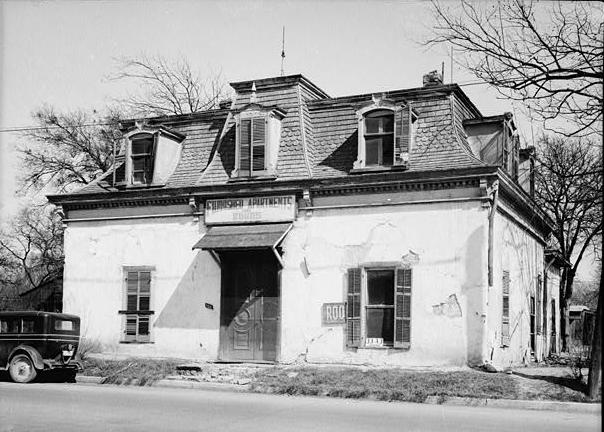
Everybody will give you a different answer. Forget asking a Real Estate agent. They call anything that they don’t call Colonial a Victorian.
Let’s ask Wikipedia, which is generally edifying if not always supremely accurate.
- British Arts and Crafts movement
- Gothic Revival
- Italianate
- Jacobethan (the precursor to the Queen Anne style)
- Neoclassicism
- Neo-Grec
- Painted ladies
- Queen Anne
- Renaissance Revival
- Romanesque Revival (includes Richardsonian Romanesque)
- Second Empire
- Stick-Eastlake
- Industrial architecture
All that happened while Queen Victoria was parked in a palace, but I’m not sure that’s exactly what defines the term. And America is different than the British Empire, of course. Arts and Crafts in America is decidedly post-Victorian, but it was born in Britain with the old girl still on the fancy chair in the drafty castle. And we’d call Jacobethan “Jacobean” here.
In architecture school in the 1970s, the short answer was: anything after the mansard roof showed up. (That’s a mansard roof in the picture at the top of the page. It appears Dillinger is parked outside the house.)That’s Second Empire style. I know, that’ s a little odd, as the “empire” they’re referring to was Napoleon III, not the lady from the gin bottle. But I don’t make the rules, I just report ’em.
Others lump in Greek Revival. I don’t. I prefer the definition best summarized in the term: “picturesque eclecticism.” Before that was simply Revivals: Greek, Gothic, Romanesque, Renaissance. I have a book published in 1973 called “Victorian Houses- A Treasury of Lesser Known Examples” that I refer to often. Victorian houses were way out of favor in 1973. The less-is-more brutalist zeitgeist was raging then, and urban renewal schemes had been bulldozing Victorian houses by the neighborhoodload and putting up concrete dovecotes for humans in their place. The introduction for Victorian Houses puts it bluntly:
The architectural monstrosities of the Victorian period have been created by twentieth-century ignorance. Ignorance, the root of religious bigotry, racial prejudice, dread of divergent social systems, and repulsion to unfamiliar forms in music, drama, art and architecture, is a deficiency in the perceiver, not it the thing perceived. Modern people, subscribing to the organic principle in building (whereby outer forms follow inner function), naturally would lack understanding of the Victorian practice of arranging rooms in masses built for pictorial effect. ..The traditional theory in Western culture is that architecture is style… applied to structure. The Victorians brought the concept to its logical conclusions. Theirs was a world rich in the accumulated motifs of past civilizations, from which they borrowed copiously, and — it must not be overlooked–to which they added creatively…Contemporary critics accuse the Victorians of needless complexity, of extraneous clutter. But is this not a frank admission of the 20th century failure to comprehend the 19th century attraction to design articulation? Theirs was an architectural vocabulary full of meanings to which our eyes and ears have become insensitive, and of which our minds have become ignorant.
Wow. Preach it, brother. You’ve poisoned your minds towards the Victorians, and it ruined your appreciation of their architectural accomplishments. People in America began to associate Victorian houses with a life that vanished in the Depression. Inchoate blame was ascribed. Victorians were the haunted houses in every movie.
Anyway, we have lost a little perspective on Victorian architecture. If you need proof of what’s been lost in the less-is-more fetishism of the last fifty years, take a look at what happens when folks try their hand at adding decoration to their homes in an attempt to achieve any sort of Victorian, or even just mildly picturesque, effect. They paste on a few gewgaws and lose interest. It’s much harder than you think to make a dense riot of decoration. A high style Victorian is a very sophisticated thing, and required a deft touch, and a lot of nerve.
At any rate, we can wander around the world of the cobweb-catcher Victorian home for quite a while. There’s lots to look at and be interested in. That’s what the Victorians thought about the whole wide world, after all.

Recent Comments