Leaving The Musical Kid’s Table


I like to keep it light, most days. Life is not without its travails, and I don’t go looking for trouble where it ain’t, as they say. Anybody who’s actually had a job on which they depended for their daily bread where someone was yelling at you will never again have a radio on with someone screaming at you in 4/4 time.

I don’t tend towards the saccharine either, and so I am not allowed the refuge of the lightweight ditty like others of the no yelling persuasion. I like country music, but I haven’t heard any for forty years. There’s some Journey with Stetsons on the radio dial where Country Music used to be found — at least figuratively found; I’ve never heard a country song on the radio I cared for since FM radios were installed in cars, and I don’t know where to look for it.

I don’t mind pop music as much as many of my friends because I don’t pay much attention to it. If you think it’s important, than you can get awful fussy about whether Def Leppard was better before or after the drummer lost one of his arms. I just worry if one arm alone can stand all the tattoo ink. And turn the dial.

There are times when you desire to listen to music made by people who take what they’re doing seriously. Respighi and Mozart and Vivaldi and Handel and Satie and Schumann and Beethoven are always handy to have around, and unlike Lindsay Lohan discs, they’re cheap. I guess it costs a lot more to cover an acre of floozie freckles in pancake makeup for the cover photo and hire four rock musicians and a studio for an afternoon than to get forty or so all-world classical musicians and an opera house. And two microphones.

But Mozart and his brethren don’t suit all moods. You need something that percolates with the bubbles of modern life, and breathes the sooty air of a downtown streetcorner. You need pleated naugahyde that squeaks when your date’s leg scoots across it, gin in a real glass, bad lighting everywhere but the center of the stage, and that stage raised but six inches, a salesman in the corner by the cigarette machine opining on the pay phone, you need to hear a siren go by occasionally and faintly, and you need to see the back of a neon sign like an irridescent snake wending its way across a window. What you need, is to sit in an upholstered chair,conjure up that scene in your mind’s eye, and listen to Blue Note records. Forget mind’s eye gin, though, get Bombay and a real lime.

Blue Note records were for people who wanted to listen to artists searching for beauty, and truth, and meaning, and rhythm, and style, and immediacy; artists that had the temerity to search at the margins of musical possibility because they had mastered their instruments first, and so could try to master themselves, and the world, and the cosmos. Their journey would take various and wonderful turns, like a river that meanders, cutting switchback on itself, labrynthine, mildy disorienting, skirting the disquieting feeling of walking too close to a precipice to see the view, and then find the broad stream of the mighty melody again and drifting with the current home.

It would take effort on the listener’s part, sometimes, to appreciate what was going on. This was the challenge dropped at your feet. “We’re going out where the map says: “Here be Monsters.” All the spices of the Orient and beautiful exotic girls and dervishes gyrating and spinning on magic carpets await us… if we make it to the other shore.”
“Wanna come?”

The View From The Trenches

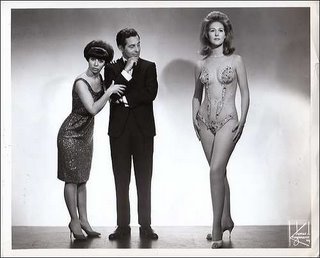
Someone’s got to play in the lounge in the chinese restaurant. (Click to see Flickr photo sideshow. Don’t worry, that’s the raciest one.)

Well, that’s not fair, really — at least around here in New England. I’m a little out of the circuit, and have been for a while; but if memory serves, the lounge in the chinese restaurants in these parts have really good Country and Western cover bands in them. There aren’t any lounge singers that look like 150 pounds of ground chuck in a 100 pound satin sack in there. And maybe it’s not fair to the people in the photos, either; maybe they’re more fun than a picnic for people with delirium tremens would be for a hungry ant. And even though some of them seem to have attended too many picnics for their spandex, we really have no idea who any of them are. Maybe they were swell.

I don’t remember where I first saw these photos, but they lead back to something called Sharpeworld, a place where someone definitely has an eye for the obscure and odd. And if this isn’t obscure, and odd, I don’t know what is.

These photographs were found in the trash and rescued from oblivion; the oblivion that time will bestow even on entertainment much more popular than the people on the photographs. These people seem to be equipped with a sort of instant oblivion, like they’re black holes for charisma. They’re the lounge entertainment version of Men in Black :In a flash, you’ve forgotten you’ve seen them, and even forgotten what you yourself were doing when you saw them. Some have faces that can stop a clock, all of them make the clock run backwards.

It’s a wonderful array of the people who were playing at the wedding of your distant cousin — you remember, you got food poisoning from the chicken and shells; the comedian hired for the Rotary Club Medal of Achievement dinner you missed because you had the flu; the combo on the deck (in the rain) at the golf tournament banquet from that course under the high tension power lines — where you got poison ivy; and the stripper that wouldn’t take any of her clothes off from that lounge your college buddies from upstate took you to as a hoot. You may have been too drunk to fully appreciate them, or maybe the acts were too drunk, who knows? Anyway, everybody draws a blank here.

It’s not the photographer’s fault. The pictures were taken by James J. Kriegsmann, who by all accounts was no slouch. I went looking for Kriegsmann, and was astonished by what I saw.

He died in 1994. He was born and educated in Vienna, Austria, and in 1929 came to New York and started photographing celebrities.

And what celebrities! Michael Ochs Archives has a wonderful set of some of Kriegsmann’s work, and the people in them are astounding. Frank Sinatra, Ella Fitzgerald, Stevie Wonder, Eartha Kitt (rowr) Cab Calloway, Charlie Parker, Miles Davis; dozens and dozens of the most famous acts in the world for decade after decade.

I imagine that Kriegsmann’s notoriety among the glitterati brought the lumpen people to his doorstep, thinking that if they plunked down the cash, some of the leftover celebrity might still be in the lens. And so Kriegsmann worked, and worked hard, and made the same attempt to portray these subjects as sympathetically as he could. It boggles the mind what they must have looked like when they walked in his door.

The proprietor of Sharpeworld put these on Flickr hoping that someone would remember something about these folks. It’s a fool’s errand, I’m afraid. Would you remember who was singing O Sole Mio in the Terminal Lounge in 1979 in Trenton when you went in to get out of the rain for five minutes to use the pay phone?

Though we laugh, the camera was kind — in that it captured them as they wished to be, and maybe as they were, at least for one or two brief shining moments: Somebody.

Getting Your Haircuts From Dog Groomers, And Other Discontents


You’re really not supposed to take pop music too seriously. That goes for the audience, too. It’s just supposed to be fun, and ephemeral, and that’s it. You’re not going to save the world with your two minutes and forty eight seconds of foot-tapping goodness. And generally, introducing much more than foot-tapping to the proceedings brings the whole edifice down on your heads. You can’t make bubbles out of iron.

The Beatles killed pop music, though it was not their intention. They could write very high quality pop, with just the right balance between sophistication and raucousness; and if you set up two boom mikes and their instruments, they could entertain you.

But they went searching for the holy grail of seriousness, and they began to put together pop confections by using the entire array of studio technology available at the time, and so made music that was not possible any other way –the studio album.

The records they made were almost uniformly wonderful, so where’s the problem, you’re asking? Well, everybody else is busy Not Being As Talented As The Beatles, but they’re using the same techniques plus all the other aural spackle and visual wallpaper to make studio silk purses out of the sow’s ear of their meager talents, and then compounding their errors by taking themselves seriously. And we have to listen to it.

There’s a lot of potential to make interesting cultural artifacts with the studio system. But its been taken too far, and simply made it possible — if not required — for the most avaricious and outrageous among the already mildly inspired to elbow their way to the front of the pop music line. It’s killed the thing that spawned them, for all intents and purposes.

A few friends got together in Wales forty years ago, and played in some bands together. They didn’t take themselves seriously; their very name was an offhand joke — The Iveys, after a street in their town, and a play on words referring to the pop group The Hollies.

They learned how to play their instruments and sing a little, and made friends with the Beatles. They changed their name to Badfinger, apparently a snippet from a working title of a Beatles song. And when you’ve got the Beatles helping you out — at least the ones not named John Lennon, who thought you too, well, unserious — you’re likely to do OK. It doesn’t hurt to have Paul McCartney singing back-up on your songs, like this one, (knock down the old grey wall) and George Harrison and his friends playing on your others.

Thirty-five years ago, simple, lyrical, happy, glittering pop used to come out of the radio every few minutes, like No Matter What. It didn’t save the world, or grant any inner peace or enlightenment, it didn’t rage against the… well, let’s just say, there was no rage in it at all. It was fun and vibrant, harmless and marvelous.

Those Welsh fellers with the little knack it took to write tuneful nursery rhymes fell in with gangsters and lawyers, or the other way around; in the music business you need dental records to tell them apart anyway. They made all kinds of money and got all kinds of girls despite their golden retriever haircuts, bad teeth, and sunken chests. They managed to get their own sort of Yoko Ono. They took themselves very seriously, and two of them eventually hanged themselves over the idea that it all mattered a great deal more than it does, or should.

My friend Steve calls suicide “The permanent solution to your temporary problems.” It was better, for everybody involved, when they were supplying us with the temporary solution to our permanent problems, at least for two minutes and forty eight seconds.

Month: May 2006

Find Stuff:

Archives