Well this kind of weather couldn’t last forever, amirite?
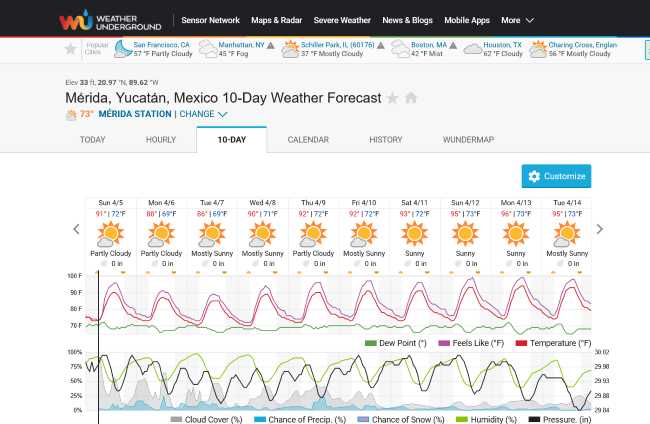
I must admit, for someone accustomed to New England weather, it seemed like forever. Merida, Yucatan shifts its seasons, it’s true. But not while you wait, the way it is back in Maine. Yucatan uses a calendar for weather decisions. Maine uses a clock. Summer in the sun, winter in the shade is a thing back there. Here, it’s always some form of summer.
Forgive us for being lulled and gulled by a weather report that looked like it was painted in oils. We went something along the lines of 45 straight days just like you see there. Egad, Lovie! We have to put more water in the pool every day!
It couldn’t last. The seasons are the opposite of up north. Winter’s nice, summer, not so much. There are only two seasons, just like Maine. Maine is nine months of winter, followed by three months of tough sledding. Here in Merida, there’s summer, followed by the other summer.
The “other summer” is the rainy season. If you want to be pedantic (who doesn’t?) there might be a third season: hurricane season. But honestly, how much worse can it get than the “other summer,” which showed up here last week:
That’s out in front of our house. There’s an eight-inch high curb out there, which is a lot by US standards, but barely adequate here. The city of Merida is the geologic equivalent of one of those pool tables without pockets that require more geometry to play than I carry around in my head. There are no bodies of water, no rivers, runnels, or gullies where the water might go. Either it ends up in the ocean, or the Gulf, the occasionalcenote, or your living room.
Obviously this has been noticed by the people who lived here before us. I espied two brackets anchored into the masonry walls outside the only door in and out of our casa. I’m good at architectural hints. For instance, if you remove all the railings on your staircases, because a raccoon-eyed harridan on home and garden TV told you to, I’ll take the hint and fall down your stairs and sue you. I assume that’s expected of me. I hate to disappoint people.
The bracket hint was saner than that. I went hunting around and found a six-inch tall metal weir, a dam that slipped into the brackets snugly. So between that and the curb, we had about a 14″ head start on the rainwater. It wasn’t enough:
Consecutive days of torrential downpours have left the city of Mérida waterlogged, with official data revealing that parts of the Yucatecan capital recorded a staggering 436.7 millimeters (17.2 inches) of rainfall over a single seven-day period.
According to a report released on Wednesday, June 3rd, 2026, by the National Water Commission (Conagua), Mérida has solidified its status as the wettest location in Mexico over the past week. The most severe accumulations were registered in the western sector of the city between May 27th and June 2nd. Conagua noted that the 436.7 mm volume is visually equivalent to dumping nearly 22 twenty-liter water jugs onto every single square meter of land in the area. (link)
They were eager to add several rainstorms together to get that figure. There were days scattered throughout that week when it didn’t rain much, or at all. Most of that 17.2 inches of rain fell in a few hours, scattered over several days. It only rained all day once. I’ve taken showers with less water being dumped on me.
According to the chatbots, 17.2 inches of rain is about half the expected yearly rainfall here. Also according to Chad:
Spread evenly, 17 inches of rain means every square foot of ground received about 106 gallons (400 liters) of water.
Now, I may not be able to play pool with no pockets or anything, but I know when Sam Altman’s turbo encabulator is having an aneurysm. I said, check your math, and yourself, roboboy:
Good catch — that number is way off.
Let’s calculate it correctly.
A square foot receiving 17 inches of rain gets a volume of:
17 inches of rain means every square foot of ground received about 10.6 gallons (40 liters) of water.
The previous figure of 106 gallons would correspond to about 170 inches of rain, which is exactly 10 times too high. I accidentally shifted the decimal point.
Do tell.
For poops and giggles, I asked Chad how much snow that would be, if that much moisture fell on Maine.
Maine perspective
A week’s precipitation equivalent of 17 inches of rain would translate to roughly:
14–21 feet of snow in a single week.
So, about four to six hours after I took the video, all the water in the street was gone except for some puddles. Where it went, only Kulkukan knows. The pool was full. And I didn’t have to shovel 14-21 feet of snow off the sidewalk.
Hampus Granstrom is quite the shade tree mechanic. He’s apparently based in northern Sweden, so the shade trees are really tall, and throw as much snow as shade. Additional information about him is not easy to find, and what I could discover was in gorny gorny umlauty lingo, so I’ll give it a pass. Let’s just agree that the fellow is a wonder, and leave it at that. I especially liked the long-winded, extensive explanation of his background and worldview he offered on his YouTube page:
Description:I like cars.
I guess so. Me, I liked watching a video of him restoring a ’66 Volvo, start to finish, and found it to be some brand of awesome. I’m fairly familiar with ’66 cars, having owned a couple of them back in the day. Unlike Hampus, mine were at least running when I got a hold of them. I had to make all sorts of repairs to them to keep them running, but nothing major like his videos. I was an auto dermatologist, maybe a bit of a chiropractor. Hampus is both a thoracic and a plastic surgeon. I dunno, maybe a psychiatrist, too. Here’s that video:
Having fixed the same vintage car helped me to understand what a fantastic worker Hampus is. I’ve done the bondo repairs and paint and drum brakes and seat covers and suspension and I don’t know what-all besides. Watching him do it, I felt like a guy who painted the walls in a room while Valasquez worked on a canvas in the middle of it. We both owned brushes. That’s about where the similarity ends.
The first video, the one with the abandoned Saab, really killed me though. Whenever the first tool you select to start an automotive restoration is a chainsaw, you’ve entered another dimension. The molecules of that Saab were barely holding each other’s hands, and he ended up driving it through the primeval forest with the unpaved road scrolling past under his clutch foot like some Scandi Fred Flintstone.
On top of everything else, Hampus simply points the camera at the thing that is happening, says nothing, and doesn’t seem to own a radio. If you notice anything wrong with his videos, his general approach, or his particular skills, feel free to point it out. Forgive me if I won’t stand on one leg and hold my breath while waiting for you to do it, however.
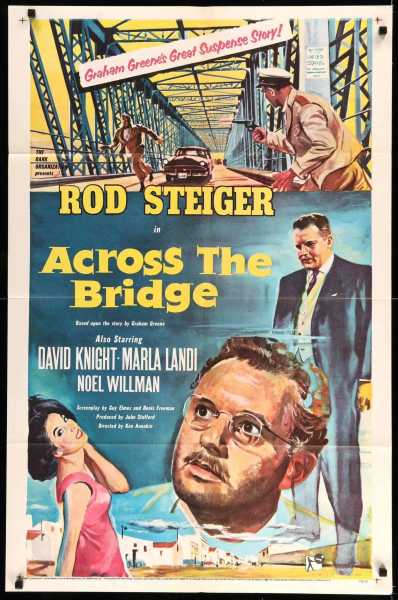
I’m not sure if Across the Bridge is a great movie. I’m pretty sure it’s not. It might just be a good movie, not a great one. Then again, maybe it’s a so-so movie, and I haven’t noticed it. In any case, it’s a great story, I tell you what. Crackling tale. Sometimes that’s enough.
It’s a British production from 1957. Most reviewers would tell you it’s in glorious black and white, or luminous black and white, or gorgeous black and white, or something similar. I’m sure the producer would tell you the same thing he told the director: It’s in inexpensive black and white. Simple storytelling doesn’t really need color anyway. Why pay for it?
If it’s in black and white, and it’s got a crime in it, many would call it film noir. It’s got plenty of crimes in it, committed by all sorts of people, and it’s in black and white, but there’s barely a hint of noir in it. It’s a British production, so they didn’t call movies that anyway. Brits would have called it a Crime Drama, or something similar.
Film Noir is of course a French term, but the style really didn’t originate there. It got a workout in Hollywood for nearly 20 years. They used the dearth of light and the ton of dark in the movies to add suspense, or a feeling of danger. In a way, the shadows themselves became characters in the movies.
That’s good, because a lot of noir films were pretty bad, and the characters weren’t very interesting. They needed the assist that moping around in the dark added to their mystique. With the lights on, you might notice Alan Ladd was only four feet tall, for instance.
Across the Bridge isn’t like that. Rod Steiger plays Carl Shaffner, a wealthy, abrasive jerk, who made his money the old fashioned way: Two sets of books. For some reason or another, Steiger plays him with a German accent. I guess in 1957 England, that was enough to identify villainy to the audience. Or maybe Steiger couldn’t be relied upon to sound British to a British audience, and they didn’t want him to sound American.
The original (short) story is by Graham Greene, who is a very sneaky writer. If you’ve ever read any of his books, they wander along, simply telling you what happened, and then every once in a while, the lull is broken by some memorable turn of phrase, or a trenchant insight into the human condition. There’s a reason fireworks always look best after dark. Another Graham Greene story that is more closely aligned with American noir sensibilities is The Third Man. Got a femme fatale and everything.
Across the Bridge is no The Third Man. It’s smaller in scope, although it travels from London to New York to Mexico. Greene was very familiar with Mexico, having lived there for a time, and his greatest work, probably, was The Power and the Glory about the Cristero War in Mexico. Of course being a British production, London was London, New York was London with some cardboard skyscrapers outside the set’s windows, and Mexico was Spain, because the airfare was cheaper.
The director was Ken Annakin. Workmanlike director. He had none of the moviemaking dazzle in his haversack that someone like Carol Reed brought to The Third Man. Extreme closeups and the occasional Dutch Angle were about it. Annakin was well-liked and hard working. His filmography could be labeled “value for money,” including one movie actually called Value for Money. He worked for Disney, who was definitely a value for money kinda guy. He never hired hacks, but no one got rich working for Mauswitz, except Walt. Annakin did Swiss Family Robinson for Disney in 1960. It was a big hit, and made a pile of money. It’s one of those movies the people who run the studio apologize for now, because the Asian pirates aren’t the heroes. Ho hum.
Across the Bridge has an expanded plot compared to the short story (duh), which includes more of a backstory for the main character. There is a fascinating byplay between the ostensible villain, played by Steiger, a Scotland Yard man sent to fetch him from Mexico, played by Bernard Lee, and the Mexican police chief, played superbly by Noel Willman. Both policemen are like the married man who is propositioned by a particularly fetching prostitute. He protests, “I’m happily married, and I don’t fool around. I will, however, hold still while you do.”
There are many reversals in the plot, but none of them feel forced. It’s interesting to note that every single person in the movie, more or less except one, is behaving badly the whole time. They are all trying to get what they want, no matter how sleazy or corrupt the methods they have to stoop to to get it. Everyone’s connivances come a cropper when the worst of them performs what is no doubt the only decent thing he’s ever done in his whole life, and wrecks it for everyone.
So I’m not sure if I can tell you that Across the Bridge is a great movie. I can report we watch it about once a year. We enjoy watching desperate people doing desperate things, while a bunch of people who think they’re honest forget what honesty is. We might watch it to see Dolores, the abused pooch with the sad eyes, as she teaches the human race a little lesson.
I’ll leave it to you to tell me if it’s any good. I guess it can’t be great, because instead of pasting a clip from the movie here, I’ll just paste the whole thing. If it was great, someone would still be trying to make a buck off it.
We’re in Merida, Mexico. Doing the Yucatango. Figuring things out. Mexico decided to be extremely Mexican on Sunday. Forecast: 103. Electricity: Coy. Disappearing puckishly from time to time. No dear John letter, either. Just wait and wonder in the dark.
Now of course there are many things you can do without electricity. Like most people, I don’t want to do any of those things, and I don’t want to hear about those things. I want coffee and air conditioning. Don’t take me alive, otherwise. A ready supply of these things are mentioned in the Geneva Conventions, or maybe the Magna Carta, or perhaps the terms and conditions on Microsoft Office. If they’re not, they should be. I’m no Revolutionary War scholar or anything, so I may be misremembering, but I’m pretty sure the Intolerable Acts threatened no coffee or air conditioning for expats, which I guess Americans were. Or maybe it was tea. It was always about tea with those periwigged weirdos.
It was early yet on Sunday, so we set out on an overland trek. An ankle turner through Santiago, the neighborhood we live in. The eastern end is called Gringo Gulch by the locals. It’s a not entirely complimentary assessment of where most of the expats from the US and Canada live. We don’t live in Gringo Gulch. We live on the western end of Santiago, near the zoo, which is somehow fitting. We are similarly displayed to the regular residents as oddities. Like the zoo, strangers are not expected to feed us, but on the plus side, nobody is allowed to throw stuff at us, either. We’re happier among the locals than we would be in Gringo Gulch. If we wanted to live among Americans, we would live in Maine. If we wanted to live among Canadians, we’d live in Maine in the summer, and learn to tip seven percent in the restaurants.
We walked east, because that’s where the Plaza Grande lurks. Some call it the Plaza Principal. Some call it the zocalo. It’s the center of town, done in the Spanish colonial style. Big square park, big cathedral on one side, town hall on another, governor’s palace on another, and a museum on the fourth. Mixed in are 1001 opportunities to ask a gringo if he wants to buy a Panama hat, or a fan, or a guayabera shirt, or another fan, or a trinket, or a ride in a carriage drawn by a horse that looks like he’d rather be in perdition, where it is cooler. We didn’t want any of that, but we figured where there’s commerce, there might be electricity.
We walked on the shady side of the streets. It was almost lonely, although the city has about a million inhabitants. Mexico is a civilized country, the way my own used to be, so lots of businesses are closed on Sundays whether they have electricity or not, and the churches are full. I doubt they’ll withstand the siren song of American go-go franchise commerce much longer, what with all the stronk girrllbosses running the place these days. But there’s a lot of ruin in a nation, as they say, and it will take time, so it will be a problem for the people who mow the lawn over our graves, not the residents under it.
I confused my wife over and over, which is in the job description, I believe. What with everything shuttered, and regular people in church or sleeping one off, or doing both at the same time, we didn’t encounter very many pedestrians, and it was easier to cross the streets than usual. But somehow, I kept stopping here and there on our hejira. I wasn’t taking pictures, or anything else borderline sensible, so my wife had to keep stopping and tapping her foot with “I did?” rattling through her head where the “I do” used to live.
“What the hell are you doing?”
“All the electric meters are six feet off the ground. I’m watching to see if the wheel is turning inside the meter. The first one we find that’s in motion, I figure we can knock on the door, kill the inhabitants, and make coffee in their kitchen until the police come.”
“It’s a strong plan, I’ll grant you. Maybe we could just go to the first restaurant with the meter humming?”
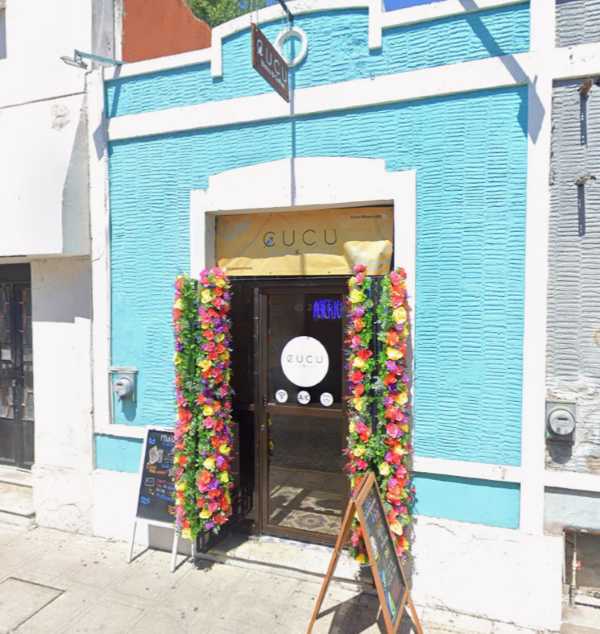
Isn’t it just like a girl to take the easy route. We wandered along past Santiago Park, and kept going. When the zocalo appeared a few intersections further along, still only a mirage full of traffic and importuning, we passed the Cucu. It was open. I realize that “passing the cucu” sounds like a euphemism, but I assure you it’s a restaurant. My wife and I switched roles. I walked right by it, while she paused at its sandwich board.
It looked Mexican twee to me, which didn’t suit. I wanted coffee like a bitter penance, and a breakfast like the kind they serve in prison. The Cucu Bistro doorway was ringed with a garland of plastic flowers, and the sandwich board described the kinds of complicated breakfasts I don’t favor, the kind designed to fool girls into thinking they’re not eating right out of the sugar bowl like a housefly. You know, Starbucks sorts of things. Wedding cakes for breakfast. I pooh-poohed the idea thusly:
“I’ll bet they don’t have air conditioning.”
“There’s a big sign on the door that says ‘air conditioning’.”
“Reading the signs is cheating.”
By this time, a cute little girl (I’m getting old) opened the door and said, “Come in, we’re open, and we have coffee and air conditioning.” At least that’s what I think she said. She said it in Spanish, and I was still in arguing with my wife in English mode. It takes a few seconds of hummina hummina when you switch back and forth. She may have asked me if I wanted to buy a Panama hat, or take a hansom cab ride. My wife went straight in. I was left on the curb with no one but her imaginary divorce lawyers to keep me company. I surrendered faster than Vichy France and followed.
I was disappointed that the interior was as pleasant as the help. It was getting harder and harder to win the argument. The place was like most structures in the city, very skinny and very, very deep. We kept passing through seating areas, past a station where the servers made coffee and conversation, until we hit a door out to a hidden patio. We were about as interested in sitting outside as do-it-yourself dentistry, so we plopped down in the last stretch of seats, right under the mini-split, and looked around. The place was as neat as a pin. It had handsome tile floors in the big, colorful patterns they favor down here. The overall color scheme was a peaceful yellow and gray, with dashes of blue. The tables were simple, sturdy, nicely finished and well-matched, made from the kind of lumber rich suburban American women salvage from pallets, because they wish to appear poor and resourceful, and fail at both. No one was failing at anything at the Cucu.
The siren who lured us in was our server, and continued her song. She took pity on us, though, and she fished around and found menus in English for us.
Aha!, I thought, but didn’t say. There was nothing on the menu for me. I still held out hope that I could win this argument, if that’s what it was. It was the usual lament. Complicated mayonnaises and avocados everywhere. As you know, avocados are just rancid pears full of green gun grease and a giant kidney stone. Mayonnaise of any kind is suitable for several uses, none of which involves eating at breakfast unless you’re more of a honkey than I am. The rest of the menu was runny eggs and runny cheeses and various other things not often sold to drunken Irish authors, which I aspire to be. They had coffee and air conditioning, so I didn’t complain much. As usual, my wife saved me: “They have grilled cheese and tomato soup.”
I know what you’re thinking. This dude is in the Yucatan peninsula and he’s going to order a grilled cheese sandwich with tomato soup. He must miss grammar school lunches. Perhaps they should serve it with a waxy box of milk to complete the trip down memory lane.
But you’d think wrong. Merida is actually notable for its Yucatecan cuisine, which in my book should be treated as assault in a court of law. It’s all pretty dreadful and strange, and it has no visible relationship to what anyone in the US thinks of when you mention Mexican food. Everything on the menus looks like you cleaned out the kitchen sink strainer after doing the dishes and dumped it into that dish you keep under the sink if the drain leaks. They put chocolate on chicken down here, among other horrors. It gives me the willies.
Think I’m exaggerating? Challenge accepted. Their signature dish is cochinita pibil, At first blush, if your Spanish is rusty and you’re not too inquisitive, it sounds like a pulled pork sandwich. Dig a little further, and you might find your appetite for it wanes. And I really mean dig a little further, because it’s prepared by drowning the pig in the juice of bitter oranges (don’t ask), then wrapping it in banana leaves, followed by digging a hole, starting a fire, and burying the pig on top of the coals in your backyard overnight. The next day, you dig it up, dust it off somewhat, eat it, and pretend to like it.
I’m of Irish extraction, so sketchy uses of various parts of pigs hold no terrors for me. But I, and my brethren, draw the line at grave-robbing.
So no, I am not fondly remembering Mom’s margarine pan-fried Wonder bread sandwiches with two slices of American cheese, along with a bowl of Campbell’s tomato soup with an extra cup of water added, because there were six of us. I’m trying to explain that Merida might be known for cochinita pibil, but should be known for its grilled cheese sandwiches, with tomato soup on the side. It’s Elysian here.
My wife ordered this, because she is, underneath her clothes, a girl eating breakfast in a restaurant:
Yup. Whipped cream, blueberries the size of plums, various sugar grenades disguised as fruit, and flower blossoms on top. A wedding cake. I figure anything that reminded her of a wedding cake would turn to ashes in her mouth, what with her husband selection experience, but she soldiers on.
We’re in danger of taking photos of all our meals while writing on the internet. This would make me an influencer. I avoid being called that by always being under the influence instead. Let’s move on. Here’s mine:
The menu reads: Pan rustico + queso de cabra + queso gouda + queso cheddar + tocino + sopa de tomate.
By rustic bread, they’re referring to bread made for humans to eat, by other humans. Big fat, chewy slices that taste of sourdough, maybe a little olive oil, and perhaps a rumor of the wood-fired oven they were baked in. Three kinds of cheese, just not made in the same factory that makes Firestone tires and kamikaze drones like back in the states. The tocino they mentioned is just bacon, in the same way Sophia Loren is just a woman. I don’t know what they feed pigs down here, but it must be more wholesome than cochinita pibil. This also avoids requiring cannibalism as well as grave robbing from the oinkers.PETA would be proud. Almost.
The tomato soup is as thick as hummus, and made entirely by smashing fresh tomatoes in some sort of soup particle accelerator, with some kind of ambrosia for spices. It’s served in a little cup, and you’re supposed to dip the sandwich in it, and eat it like that.
Now, I’m not just going Cucu here. I’ve had the same meal in four different restaurants all over the city. The SOCO. Maria and Montejo. The Galeron. And in each one, in turn, I’ve testified, under oaf (my mouth was full), that it was the greatest grilled cheese and tomato soup combo in the history of the world. And every time I knew I was wrong, as soon as I ate the same thing in the next restaurant.
You know, the historic center of Mérida is protected under Mexico’s national heritage laws as a historic monument zone (Zona de Monumentos Históricos). They list all sorts of architectural and historic reasons for that, but they can’t see the forest for the trees. Put the grilled cheese sandwiches and tomato soup on the city’s seal, and all the flags, and see the tourist dollars roll in. I promise only a small portion of them will leave a seven percent tip.
If we held a One-Hit Wonder Sweepstakes, I’d enter William DeVaughn, place some side bets, and clean up.
Let’s specify the rules for deciding the most wondrous one-hit wonder. First, it has a to be a big hit. It has to come out of every passing car’s radio. It’s got to rule the charts. Second, the artist has to become a trivia question. Nearly immediately is good, but anonymous in real time is even better. I give you: William DeVaughn.
The song was universal in the summer of 1974. Number 1 R&B, Number 4 Billboard. Sold two million records. Obscure artist? You bet. Everyone always thought it was a Curtis Mayfield hit. But even though no one knows William DeVaughn’s name, and prolly never did, I’ll bet a healthy plurality of people to this day start singing along when they hear:
Diamond in the back, sunroof top Diggin’ the scene with a gangsta lean
Of course everyone has always gotten the line wrong, and sings digging the scene with the gasoline. If you’re wondering what the hell a gangsta lean might mean, allow me to define it for you, because, stewardess, I speak jive. Plop your hand at 12 o’clock on the steering wheel. Fingers are OK, but using your wrist is best. Lean hard to your right, preferably with your elbow on the center console of your Olds 442, or maybe your Caprice Classic. Ideally, your Monte Carlo…
Oh, the hell with it. Just watch Denzel drive.
It’s common for one hit wonders to toil in the vineyards of music for years, banging their heads on various recording studio or barroom walls, until something finally clicks. We could illustrate that with, oh, I don’t know, how about Sugarloaf? They had a big one-hitter with Green-Eyed Lady, but that was after first plowing the musical fields without much of a crop to show for it as The Surfin’ Classics, then The Classics, then The Moonrakers, then Chocolate Hair, and finally Sugarloaf.
Not so our friend William DeVaughn. His previous experience in the music business was, well, not the music business. He was a Jehovah’s Witness. He worked as a draftsman for some government agency or another. I was in the music business for quite some time, in a modest way, of course, but I don’t remember playing with many people who had a T-square and a protractor at home. Well, besides me, I mean.
With a resume like that, it’s hard to break into the music business. William did it the old fashioned way. He paid $900 of his own money to some record producers in Philadelphia to make a demo of A Cadillac Don’t Come Easy, the original title he had for the song. It might not have sounded like something, but apparently it sounded like something that could sound like something. Luckily, they had MFSB hanging around. I’ll let Wiki fill you in who that was:
MFSB, officially standing for “Mother Father Sister Brother”, was a pool of more than 30 studio musicians based at Philadelphia’s Sigma Sound Studios.[2] They worked closely with the production team of Gamble and Huff and producer/arranger Thom Bell, and backed up Harold Melvin & the Blue Notes, the O’Jays, the Stylistics, the Spinners, Wilson Pickett, and Billy Paul.
Some portion of that wild bunch eventually started calling themselves TSOP (The Sound of Philadelphia), and had their first hit with the Soul Train theme. Even if you watched Community Auditions instead of Soul Train when you were nursing a hangover on Saturday mornings, you’ve heard those dudes. That’s them sawing away behind the O’Jay’s in Love Train, among a metric tonne of other hits. They turned William’s idea into a stone groove.
Of course the lyrics confuse everyone, as lyrics often do. They assume William was extolling the gangsta culture, but DeVaughn wasn’t giving a shout out to the various Huggy Bears of the world, who actually drove great, big Cadillacs. His intended audience was regular people who may not have a car at all. So remember, brothers and sisters, you can still stand tall. William DeVaughn said so, and for three minutes and forty five seconds, you could roll down the window, drive slow, and believe it.
sippicancottage
A Man Who Has Nothing In Particular To Recommend Him Discusses All Sorts of Subjects at Random as Though He Knew Everything.



Recent Comments