
No, I’m not talking about Bernard Purdie, shown here playing the drums with Vulfpeck, although it would be alright with him if I was. Bernard played on the original Kid Charlemagne, a Steely Dan minor masterpiece. I like how Bernard is wearing a Bernard Purdie tee-shirt. I think I’ll wear a Sippican Cottage t-shirt when I pick up my Nobel prize for literature. Or maybe a sweatshirt. I hear it gets cold in Stockholm. On further reflection, maybe they can just mail me the money and the bronze coaster with the dynamiter on it, and save me the trip.
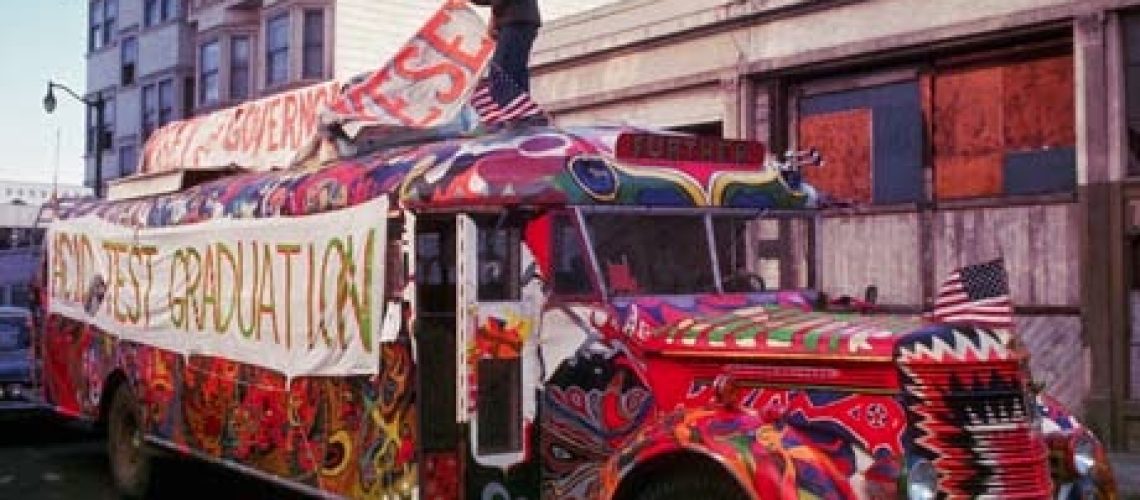
Speaking of trips, in the title, I’m not referring to Bernard, or Becker or Fagen, or even Owlsley, the LSD king that Kid Charlemagne is written about. All that chemistry was in aid of the largest deliberate experiment in subverting the culture ever attempted: The Electric Kool Aid Acid Test. Ken Kesey has had a larger influence on the United States than anyone going back to maybe Alexander Hamilton. And while it ultimately led by a very circuitous route to the wonderful agglomeration of Bernard Purdie and Vulfpeck playing Kid Charlemagne, it would be hard to come to any conclusion but one: That influence was all bad.
The Merry Pranksters, as they styled themselves, wouldn’t mind being called bad influences by the L7s, because they were rebelling against the squares. Many people thought the Pranksters were doing a good thing by telling people that drugs would expand their minds, and that these expanded minds would lead to all sorts of wonderful things, like whirled peas, face painting, and luxuriant armpit hair on women.
Well, it didn’t.
All those Day-Glo freaks who used to paint their face
They’ve joined the human race
Some things will never change
These are the Day-Glo freaks Becker and Fagen were talking about, and Kid Charlemagne was supplying with LSD:
Kesey is largely responsible for the two major problems currently haunting America. First, he wrote One Flew Over the Cuckoo’s Nest. That made him a pile of money, and earned him plenty of notoriety. It was the lever that started the big rock of “reform” rolling downhill for US mental hospitals. Of course Chesterton’s Fence wasn’t consulted, and the benighted denizens were simply turned out of doors instead of firing all the prototypical passive aggressive girlbosses like nurse Ratched and starting over. So mentally ill people get to live under bridges and yell at cars, courtesy of Ken Kesey.
Then Kesey started the sixties counterculture, nearly singlehanded, if Tom Wolfe’s The Electric Kool-Aid Acid Test is to be believed. Now that Wolfe is dead, I figured it was safe to read something written by him. My wife found a dogeared paperback copy of it for me in a used bookstore. If I’m still reading the frontispiece correctly, this paperback edition was printed in 1989, but was already the 31st edition of the thing. I’m always amazed at how well bad writing used to pay.
I’m exaggerating some. The book’s not bad, exactly. But the breathless praise for TEKAAT book seems a bit much to me. The author was trying way too hard, and ends up sounding like a stoned, short-bus James Joyce. But that was the spirit of the times. To a normal person, a species which of course has currently been hunted to extinction, hearing the drivel that comes out of their mouths, and the bad rock music, you realize that it only sounds like something if you’re stoned.
But that was the other Kesey shoe that dropped. Giving people LSD, including giving it to them unawares, is just one act in his passion play. The whole idea that it is completely normal for everyone to be stoned on one thing or another, or everything all at once for that matter, was adumbrated by Kesey and his coterie of Day-Glo freaks. I found it interesting that in the book, Wolfe describes what the merry band used when LSD was hard to get. They’d smoke a lot of weed and take a lot of speed, and reported that it gave them almost the same sort of trip. I immediately thought of today’s kids, gobbling ritalin and other ADHD drugs, which are a kind of speed, and smoking now-legal marijuana. Everything old is new again, I guess.
Downstream of all that, Kesey’s idea that any productive behavior is strictly for the squares now reigns triumphant. Riding around, stoned out of your gourd, and annoying the locals while filming it, just like the Merry Pranksters, is the number one career choice for young people these days, at least according to various polls:
- 86% of young Americans say they’d try being an influencer; 12% already identify as one, according to a Morning Consult poll (ages 13–38)
- 57% of Gen Z teens (13–26) believe they can easily make a career as an influencer, with the same share saying they’d leave their current job to pursue it
- 40% of teenagers (13–18) are actively considering becoming social media influencers, per a Citizens Financial/Junior Achievement survey
- 16% of teens explicitly want to become a “social media influencer/content creator,” ranking just behind entrepreneurship in a Junior Achievement/EY study
It doesn’t matter that there are no more squares to outrage. Grandma’s got an ass-antler tattoo and grandpa is swinging at The Villages hot tub with his current girlfriend. Whatever. Today’s young girls make endless videos of themselves stuffing comped food in their faces at various vacation spots, or take off their tube tops on OnlyFans to make a few bucks. The guys record their video games and publish them on Twitch or suchlike, and mention that they might also acquiesce to being a pro athlete, but pretty much no one wants a real job. Kesey did that.
So Wolfe’s book accidentally shows what happens the day after tomorrow when you take Timothy Leary’s advice to: Turn on, tune in, and drop out. Plenty of those Merry people ended up in mental, and other sorts of hospitals. An assortment ended up dead. Jail was pretty common. Eventually the hippie chicks learned that Merry Pranksters thought Hell’s Angels were just as merry, and invited them over for what sounds to me like a gang rape that Tom Wolfe should have called that. And the whole lovely worldview soldiered on through the decades until it reached its apotheosis in Fentanyldelphia, Pennsylvania:
It’s useful to recall that the original idea for giving Americans LSD was part of a CIA mind-control experiment called MKUltra. I guess you could call it a failed experiment, but then again, you’d have to know what they were really trying to accomplish to know if it was a failure, and almost every record of it was burned by the CIA. But a list of the known and likely participants in the “experiments,” some unwitting, sure is interesting. Ken Kesey, Alan Ginsberg, the Grateful Dead’s lyricist, James Whitey Bulger, Ted Kaczynski, Sirhan Sirhan, and Charles Manson. Nice bunch of people there. Very tuned in, turned on, and dropped out. Jim Jones had his own Kool-Aid test down in Guyana, too, and while no one can positively say the CIA was in on it, it sure sounds fishy, and one is reminded that denying they’re in on it is right on their business cards.
So what did it all add up to, really? Driving around in a garishly decorated bus, dressing in clown motley, taking drugs, and annoying regular people while filming it? Let’s go back to Steely Dan for the answer.
While the poor people sleeping with the shade on the light.
3 Responses
I’ll have been retired for 7 years come this August, and I kind of feel like I turned, tuned and dropped. Only the way we did it was by working our asses off for 45 years, saving every penny we could, and living like little church mice in the Heart of the Hive™. We turned on to getting the heck out, and into our TinyTown™ here in NW Wyoming. We tuned in to what we’ve always been but have never been able to express in the Land of Tolerance™ where every opinion except the exactly correct one is shit upon. And we dropped the heck out (only around here it’s called “Going Galt”) and stopped being productive human beings and started consuming our savings.
It’s an interesting feeling with which I’m still having a problem since I’ve always been saving money. The notion that it’s time to spend it is alien, and I have a hard time doing it. But having run the numbers, we’re gonna die with ‘WAY too much money. If they come up with some kind of physical immortality that costs a million bucks a pop we’d go for it instantly and be young and healthy but not nearly as well off. We still wouldn’t have to work for a living, though. I just gotta learn to stick a crowbar in my wallet.
So we’re drop-outs who worked very hard to get to where we can finally be lazy.
What we’ve got here is what’s called the ‘service economy’. Nobody actually does anything.
The children of the king’s knights have decided that they’d rather have the jester’s gig than all that training to fight. “Alas, poor Yorick! I knew him, Horatio”
Plenty of those Merry people ended up in mental, and other sorts of hospitals.
A hometown peer made that point in his memoir.
I read One Flew Over the Cuckoo’s Nest and saw the movie after having worked a year as an aide at a private psychiatric hospital. Because it was private, it was relatively expensive—which meant that insurance was not structured for a lot of long stays. The emphasis was on a “quick” turnaround measured not in years, but in months, and preferably weeks. Which meant that the hospital approach was not Freudian but behavioral. No time for twenty years of psychoanalysis.
There was a lot of emphasis on getting the psych patients to change their perspectives on their situation—to adopt or accept the hospital’s view of their situation. “Do it our way.” Their was some validity to this approach. After all, the patients’ approach had proven to be somewhat dysfunctional—as shown by their being hospitalized. Nonetheless, it could be demoralizing for patients to adopt the hospital view, as it overturned how they had been operating all their lives.
I viewed Nurse Ratched in the movie as a metaphor for Big Brother, a Maoist thought control type. We are doing this for your own good. Today, Woke. The model breaks down somewhat on the realization that those in mental hospitals really need help. But it still stands that Big Brother/Maoist thought control/Woke believe they are helping you.
When I read in the newspaper, 50 years ago this summer, about President Ford meeting with the widow and children of a suicide victim of a CIA-given LSD dose, I had a surprise. I knew them. The widow was the sister of a family friend. I had spent a total of 5-6 weeks at an Adirondack cabin over two summers with the family friends accompanied by the widow and her children. The widow and one of her children had been at our house once.