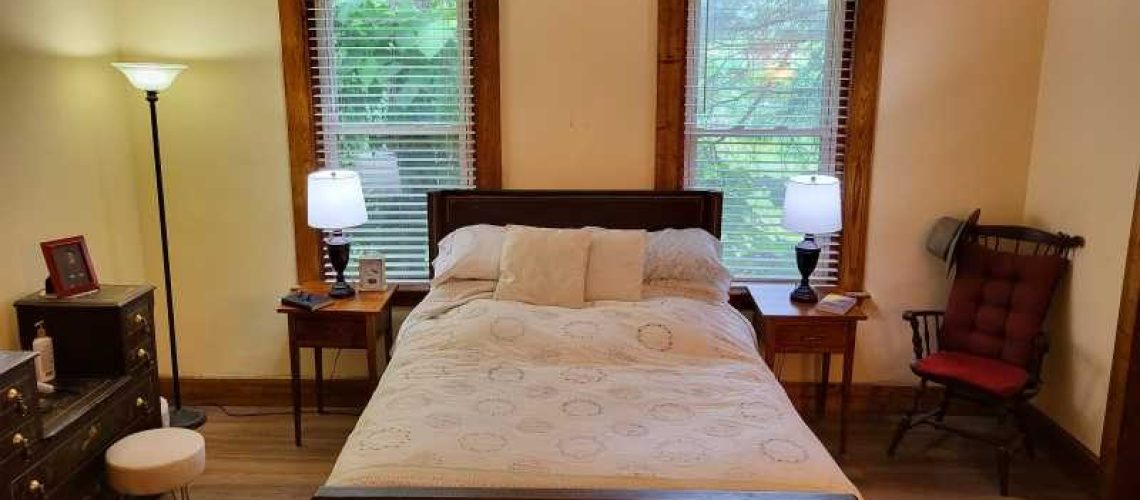


I made some tables. I have no idea why. I guess because I can. There was no crying need for them just now.
They are a form of tree fort for me. I didn’t fuss over them. I banged them together a few minutes here, a few minutes there, while I did other stuff like roofing and painting the outside of the house. They’re made from odds and ends that were stacked on shelves in the workroom, slumbering snugly under a blanket of dust. The matching end table parts had the same sort of half-life as uranium. They’ve been kicking around forever and a day. Their tabletops were a single piano bench top I was making for a reason lost in the mists of time and liquor store receipts. The sides and fronts and legs of the tables are leftover pieces from console tables I used to make and sell. A console table is meant to go up against a wall, so it’s generally wide but not very deep, like my education. I cut the parts for a single console table in half, and they were the correct width for a pair of end table fronts. The legs are tapered until they reach the aprons of the table, and then they’re square the rest of the way. I somehow had eight tapered legs hanging around. No idea why.
The wood is soft tiger maple. Soft maple isn’t soft. It’s sort of like “jumbo shrimp” in the nomenclature department. However, if you’ve ever worked with rock maple, you know why they call it that, and why they call soft maple soft maple. Everything is relative in this world, ain’t it? Tiger maple wood is great for teasing chatoyance out of it. Spell check doesn’t know what chatoyance is, but I do. My life is mostly like that.
I know “Chatoyance” sounds like the name of a disco band that plays at weddings in Provincetown, but it ain’t. Chatoyancy is sometimes called the cat eye effect. When you move past the table, the stripes appear to be three-dimensional, and shift from light to dark and back again. The wood kinda shimmers, and looks lively, even though it isn’t really doing anything. You know, like Marilyn Monroe.
I’ll tell you how to achieve chatoyance on tiger maple, for absolutely no reason. No one asked. No one cares. Hell, I don’t care all that much anymore.
First, get yourself some tiger maple. It’s not dreadfully expensive or hard to find, as long as you don’t go looking for it at the Orange Place, or the Blue Orange Place. You have to buy a lot of it to get the price down and make the delivery cost worthwhile. It gets delivered on a pallet by motor freight, generally. You will be required to run the boards through a planer, because they come rough as a rule. Specialty yards will run it through a planer for you before they ship it, if you pay them. You should, it’s a thankless task. They mostly deliver it S3S if they plane it. That means three edges (Surfaced 3 Sides) will be planed more or less smooth — the two wide faces, and one edge. If you buy 1″ thick rough lumber, you can get it planed to 7/8″ and then sand or plane it some more yourself to end up with 3/4″ thick finished work.
You have to pay a substantial premium to get tiger maple more than 1″ thick. The table legs end up about 1-1/4″ square, so you have to start out with a piece of wood at least 1-1/2″ thick, so pony up. Gluing up legs out of thin lumber is a bad idea for a lot of reasons.
You glue up tabletops by rough cutting the lengths, running the edges through a jointer, and gluing them together with pipe clamps. Regular aliphatic glue is fine. It’s just called “wood glue” most places. The spell check gagged on “aliphatic,” too. My life is like that a lot. Lots of knuckleheads on the internet will tell you that you need splines or biscuits or domino tenons between the pieces, but no one on the internet knows what they’re talking about, generally. And this essay is on the internet, so look out. Done correctly, the glue joint is stronger than the wood fibers it attaches.
You’ll have to flatten the tabletops when they come out of the clamps. I use a portable drum sander that’s 16″ wide. You can flip the table top around and push it back through to sand something up to 32″ wide. You won’t be making anything more than 32″ wide, so don’t worry about buying a bigger one, Norm.
People think sandpaper makes things smooth. It doesn’t. Sandpaper makes things uniformly rough. So you have to sand the wood with increasingly fine sandpaper, 100#, 120#, 150# grit. I use a random orbit sander. It has a bigger surface, 6″ in diameter, than the average sander. Saves time. It’s got a dust collection cowling that you hook up to a screaming shop vac. So you sand for hours with earmuffs on, dragging the same tool back and forth hundreds of times. It allows you time to meditate, or to picture what being a very bored deaf-mute is like. Take your pick.
So now you’re pretty smooth. What’s next? You wreck it, of course. You mix aniline dye in water, a dark color, walnut maybe, and you pay it onto the surfaces with a foam pad and the whole thing turns an awful brown. The grain gets raised by the water, the wood is rough again, and you have to start all over. Once it’s dry you sand it with the orbital sander through all the grits, and add 220# grit at the end. The dark dye sticks in the end grains, and is completely removed on the flat grains. Tiger stripes are the end grains billowing though the wood fibers, so the tiger stripes are revealed.

Then you mix dye in water again. This one has to be the correct color. I think these tables are a mixture of dark vintage maple, golden brown, and red mahogany aniline dye. I concocted that combo many years ago in someone’s kitchen, a happy accident, like the Three Stooges mixing everything in a rubber boot in a pharmacy. Everyone has always loved the way it looks. Me too.
The funny thing is, the water doesn’t raise the grain the second time. Once you sand down the first, nasty brown dye job, the wood isn’t impressed by a second go round with water. You can spread the dye on with a foam brush again, and if you work fast and don’t let it drool over the edges or dry while you’re working, it just soaks in the right amount and you don’t have to rub it or wipe it or anything. You let it dry overnight, and it looks kind of blah.
Then you put shellac on it. I spray it on with an HVLP machine (high volume low pressure). You have to use dewaxed shellac. Regular shellac has a waxy element in it that will repel the final finish. They call dewaxed shellac “sanding sealer” sometimes. It’s kind of hard to find these days at the usual orange and blue places. But it’s worth looking around for it. The moment you spray it on, all the tiger stripes pop right out of the wood.
It dries pretty quick. Shellac has a denatured alcohol base, which is very volatile. I sand it lightly to smooth out any “orange peel” or bugs or whatnot that gets in the finish. Just 220# grit by hand, generally. The next day, I spray on water borne acrylic satin finish. You can put on all the coatings with disposable foam brushes if you don’t have a sprayer, or you’re only working on a single table and cleaning the machine is more work than it’s worth. I sometimes spray the whole table after it’s assembled, and sometimes I finish the pieces first and then assemble them. I use loose tenons to put the pieces together.
And when you’re done, you have chatoyance.
See? It’s easy. What’s really hard is sweeping the pollen off the porch before taking the pictures. I haven’t mastered that yet.

8 Responses
theres something in everyone that needs to create, whether its a neat row of numbers that add up correctly, to music, to painting, or if there is no outlet, chaos.
I’ve always worked in metal, restoring cars and building things, cuz you can weld a mistake back together without a glue joint.
Beautiful wood, and satisfying skills and something ordinary thats pleasing to use.
Hi dadofhomeschoolers- Nice to see your name in the comments.
Welding is a very useful skill these days. Among the younger set, I think metalworking and welding is much more popular than woodworking, at least if ToYoube videos are anything to go by.
What a beautiful pair of tables!
My brother-in-law worked for a toy company a couple of decades ago building wooden toys. There was some scrap tiger maple left over, a single piece about (nominally) 1″x6″ by something like 7-1/2 feet long that he bought from the company for almost nothing. He turned them into cutting boards about 10″ long with nicely rounded edges and no finish at all except for cutting-board oil and gave them as presents.
We’re still using them today, and if tiger maple is “soft” (compared to rock maple) then you can’t tell if from these since knives leave hardly a mark on them. They’re perfect for cutting up a left-over piece of steak and cheese and setting on the deck table with a glass of wine and watching the world roll by. It’s almost a shame to waste the look of that maple on such a plebian use but we admire them every time we use them and set them out.
Thanks for sharing your pictures of them, and the process by which you bring out that grain. I’ll repeat, they’re beautiful.
Hi Blackwing- Thanks for reading and commenting and for your kind words about my tree forts.
As you probably know, besides being plenty hard enough to make a good cutting board, maple has natural anti-microbial properties that make it a great choice. And I think it’s never a shame for everyday objects to be nice to look at, besides being useful.
Regarding “splines or biscuits or domino tenons:” Mine has held up quite nicely for many years with no discernible “Ikea wobble.” It has even held, on more than one occasion, three or more cocktails with no structural concerns.
Hi Charles- We tested each table with four Fog Cutters per square foot to make sure they could take the strain. Remember to use your bartender’s guide to figure out how many Scorpion Bowls there are per Fog Cutter if you need to calculate loads.
I bought me one of those tiger maple topped tables a while back.
Still proudly supports the box with the wedding present fine dinnerware we hardly ever use, numerous tchotchkes and whatever seasonal cards friends and relative ship over.
you make tables?