
Well, if you watch the artificial news, Artificial Intelligence is going to take your job and your girlfriend, at least when it’s not too busy taking over some bunker in North Dakota and launching nukes willy nilly. You could form the opinion that AI already has taken over the world. You can’t turn on anything on these here intertunnels without some demented form of Clippy the AI assistant offering to correct your grammer, and maybe write that email for you that you’ve been meaning to send, but you can’t for the life of you remember how to spell Deer Sur.
There have been many, many laundry lists published of all the jobs that are going to be wiped out by one chatbot or another. Most everyone outside of longshoremen and prostitutes are slated to be standing on streetcorners holding signs that read: Will photoshop the background out of pictures of female footwear for use on your Shopify store for food. The usual commentarazzi are furiously analyzing the inroads that Large Language Models (LLMs) are making into the economy, and publishing their search engine optimized articles, written by ChatGPT, natch, with headers like: AI: The World Will End Yesterday. Plan Accordingly.
What is missing is some form of sober analysis. Just adding a new definition of slop to the dictionary isn’t helpful, any more than adding a new definition of vaccine kept you from getting the flu. I’m interested in the topic, however, and I finally found one lonely source that at least attempted to answer the only cogent question:
HOW ADAPTABLE ARE AMERICAN WORKERS TO AI-INDUCED JOB DISPLACEMENT?
I remember the good old days on the intertunnel when I’d have to warn you that the link goes to a PDF. It’s 2026, I think. I’m never sure until about February. If it is indeed 2026, I think you should have gotten over your fear of Adobe Acrobat by now. I suppose I could skip the warning about the format of the document, and offer a more timely warning for today’s internauts: It’s not only a PDF, it’s a 54-page working paper from a think tank, and it’s got a lot of words, some of them polysyllabic. It’s likely your lips will get really tired while reading it. It’s got numbers in brackets all over it, too, which I think lead to footnotes at the end. I can’t be sure, I never get that far without my eyes glazing over.
The working paper is from NBER. That’s an acronym for the National Bureau of Economic Research. They’re a think tank in Cambridge, Massachusetts. The locale makes my spider sense tingle. That zip code is ground zero for educated lunatic worldviews. But NBER doesn’t appear to be a big building full of Sovereign Citizens or people eating avocado toast and plotting to dye their hair pink or anything. It’s a loose agglomeration of academics and public policy wonks that seems at least modestly open-minded. So I figured it might be worth the time it took to read the report. Honestly, the question itself, how adaptable are American workers to AI-induced job displacement, demonstrates some clear thinking from the get-go. It’s long past time to stop arguing whether LLMs are real, or here to stay, or bankrupting only themselves or the whole nation, or useless, or whatever. LLMs are real, and they’re spectacular, sorta. Let’s move on. Whose ox is gonna get gored?
The paper doesn’t have a monomania for simple exposure to AI, which is great, because AI is exposing itself in more places than Hunter Biden. That ship has sailed. They’ve come up with an Adaptive Capacity Index, to see how well many types of workers will be able to adapt themselves to the new workplace now that LLMs rule most every roost. The analysis is interesting.
First they predict (or observe, really, at this point) the potential for tasks in an occupation to be affected by AI. Then they measure the Adaptive Capacity of that guy that always takes the last donut in the break room, and everyone like him. Adaptive Capacity is an amalgam of workers’ ability to adjust after the modification of their jobs (or outright displacement) caused by AI. It includes factors like liquid financial resources, skill transferability, geographic labor market opportunities, and age distribution within occupations. So far, so good. The index they came up with covers 356 occupations. They claim that’s about 96% of U.S. workforce. That’s a lot. I’ll admit I jumped to conclusions earlier, and I’m not really sure if longshoremen or prostitutes might be included after all.
If you’re of the USA Today generation, they’re looking out for you. First, a bubble chart:
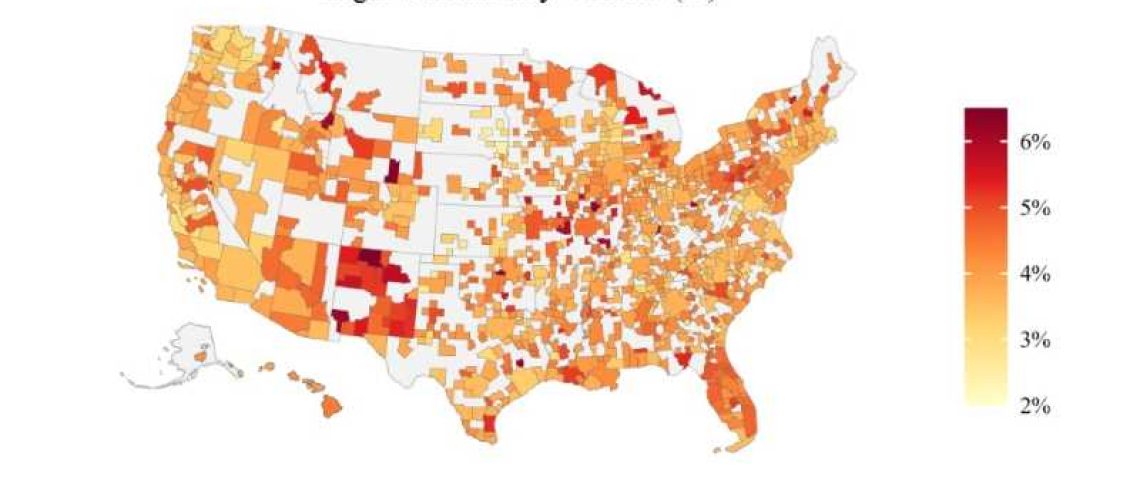
 If you’re of the Facebook generation, don’t worry. They’ve got a map showing the distribution of the population that isn’t expected to survive the chatbot apocalypse. It has colors and a thermometer, rendering it still more fascinating:

Got that? If you live where the buildings are tall enough to cast shadows, you’re in danger. If you live in New Mexico, you already knew you were in danger, just by looking out the window. A failed state, that.
They’ve got lists, if you’re from the Tumblr generation. Who’s got high exposure, but high adaptability to boot? Here goes:
 So much for all the news blurbs about software developers and various other computer nerds being put out of a job by chatbots. They’ve got the highest exposure, and the highest ability to adapt to that exposure.
So who’s on the other end of the spectrum, and the dookie stick? Who’s getting Skynetted first? Here’s who really needs to adapt, but won’t be able to:
 I suppose it would be impolitic of me to mention that there are several job descriptions on that last list that I’d like to sign up for manned missions to the surface of the sun.
Once the report has identified the problem, they go on to mention the only solutions anyone ever mentions. The government has to step in with retraining and handouts for these benighted souls flummoxed by ChatGPT. One can’t help but notice that a lot of those job descriptions are more or less either government jobs, or private sector jobs made necessary only by government regulation. Retraining? Handouts? It’s a maladaptive snake eating itself, and turtles all the way down. Maybe they can all open daycare centers in Minneapolis. It pays well, I hear.
One is also tempted to observe that the people on the first list are preponderantly male, and the second list is loaded with the distaff set, and in many cases, just plain loaded. I was tempted, but I got over it. So I won’t mention it, or parallel parking, or any other divisive topic.
See? I’ve adapted to the internet. It has girls on it now.
4 Responses
Living in NW Wyoming, I’m pretty sure that there’s not a whole lotta jobs that LLM’s, or AI, or whatever they’re calling the newest tulip bulb craze will be able to take over.
The guy who came over to the house and soldered a new water/air separator onto our boiler plumbing probably doesn’t have much to worry about, considering that the server farm in Bangladesh doesn’t know how to flux a copper pipe joint before joining it. The guy who pulled my wheel off the truck to remove the big nail/spike from the tire, and then plugged and patched it doesn’t worry about some Chat-bot fixing it for me. The poor SOB I saw out in the 20°F temperature with a gentle, warm, zephyr of a Wyoming breeze at 35 MPH blowing past him fixing a downed line doesn’t figure some guy calling himself “John” from Mumbai is going to be handing him a wire cutter any time soon.
The “AI” disaster is going to be one of the biggest economic crashes since the mortgage investment packaging bust of 2008. And the flaming morons who think that AI can do anything other than echo what the left-tards have put into it, and then lie some more, will be the last to notice.
Hi Blackwing- The report claims it covers 96% of the workforce. So I guess the other 4% are the sort of guys you mentioned. You know, the guys that make everything, fix everything, and have to wash their hands at the end of the day.
sipp.
I’m down in the Dallas area. Over the weekend we had a weather event you guys call Tuesday. The thing is we only get one day off this every two or three years so the whole place shut down. They just didn’t invest in the snow equipment you guys have. Well I have a paid off work van so I’m not risking it.
During the time off I explored if I could get ChatGPT to write me an android app. The longer the session was the slower it got. 3 days in a row I ground it to a halt. I had features I still wanted to include but feared I’d never get over the finish line. I’ve still have to figure out how to get Android developer to make it an app but maybe I can get my nephew to port onto my desk top and point me in the right direction. I’ve worked in the trades over 30 years and this fool program isn’t coming after me any time soon. I wish I could say the same about mean old man time, arthritis and whatever is going on in my left knee.
best regards and as always love to see you’re writing
Leon
Hi Leon- Thanks for reading and commenting at Sippican Cottage.
Most people wouldn’t make the connections, but Texas and Maine are sympatico somehow. There are two Texas license plates parked behind my building right now, for instance. In the summer, seeing Texas license plates around here is fairly common. Hell, country music is easily the most popular variety in Maine, which would surprise most folks “from away.”
When we were visiting Mexico, a lot of the people we socialized with were from Houston. We got along like gangbusters. The people from Massachusetts, not so much.
And I’m with you and Blackwing on this. For practical people, the Grim Reaper will arrive long before the AI reaper shows up.