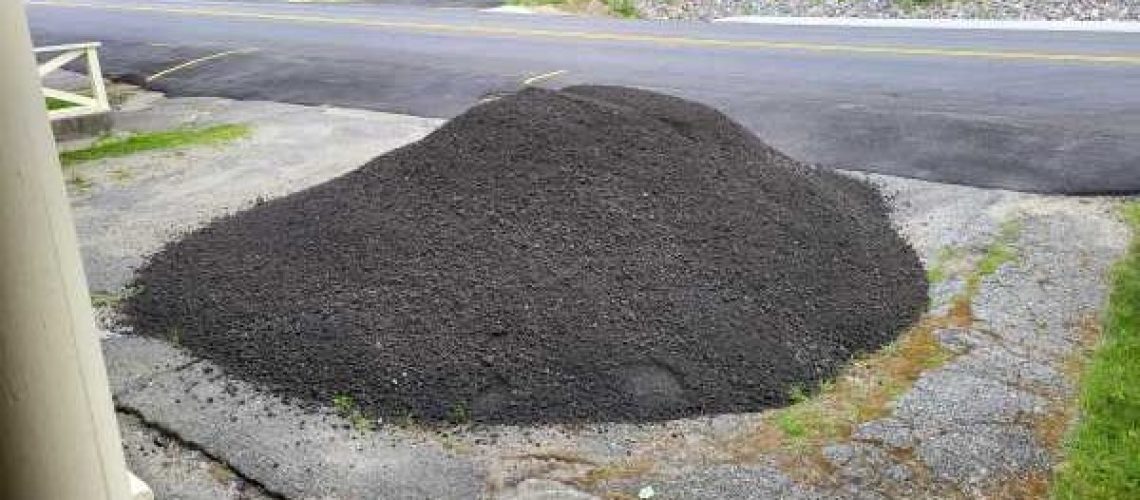

That’s not really a driveway. Here in Maine, we call that a dooryard. Maine has different terms for many everyday things. Then again, not many other places pave their front yards and park on them, and save the garage for socializing and working on motorcycles and snowmobiles. Our dooryard was a patchwork quilt of ad-hoc pavement, concrete, and dirt, seasoned with moss and dandelions. The pavement was just dumped on the earth many moons ago, and then subsided a lot. When you pulled in, your front tires would eventually drop into a gully, and your bumper would flirt with the spidered pavement in front of the trench. We decided to finally do something about it.
Pavement has a hard time here in Maine. “Frost heaves” doesn’t refer to indigestion after you eat a banana popsicle. In the winter, the ground freezes very hard and very deep. The moisture in the soil under the pavement expands, and it pushes up the pavement, at least until the spring rolls around and the pavement can collapse back into a proper pothole. These frost heaves get very large indeed, like impromptu speed bumps. They are generally ministered to by crack road crews who scramble out as soon as a frost heave is reported, and put up a sign placed just after it to warn you about the frost heave you just went airborne over.
So here at the Cottage we’re the usual amount of broke and can’t afford to hire a paving contractor to come and install next year’s frost heaves in our dooryard. We’re going to have to rely on our wits and mettle to end up with a blackish patch out front. We’re going to start with Plan B, and work down from there.
We bought a plate compactor. It’s a gas-powered sledge with a heavy steel slab for a base. It vibrates, and compacts soil, or pavement, or paving bricks, or your foot if you’re not paying attention. We bought it at the Orange Place and had it shipped to us. The FredEx driver showed up and informed me that plate compactors are heavy, so stand back, let a girl that knows how to lift heavy things handle this. She tried and failed to budge it, and then dropped it out the door onto the sidewalk. I was grateful that I didn’t have to drop it myself. Luckily, it’s not possible to break a plate compactor. Bang on it all you like, but it’s like trying to break a panzer tank with an upholstery hammer.
We called the semi-local materials dudes and ordered 10 cubic yards of recycled pavement, which people call RAP around here. When you see those huge grinders peeling up (scarifying) roads, it all gets reused. Some recycled pavement gets mixed back into new, hot asphalt pavement. Stuff like we bought gets crushed and mixed with sand and maybe some aggregate, and sold as RAP. Most people just use it for a sub base under hot asphalt paving, but you can spread it and compact it, and get a fairly durable almost-pavement. They use lots of eco-type adjectives to make you feel better about avoiding tarring Gaia with your driveway, and perhaps feathering it, too, if you don’t shoo the pigeons away first. I’ve never gone in much for that sort of foolishness. The stuff is just cheap and effective and available. Funny, that would probably make a better sales pitch, but it’s never been tried, so there’s no way to know.
I love the local folks. I had to give directions to my house, and they instructed me to institute a fail-safe, foolproof method to locate the property for the driver. Google Maps? No. Satellite location? hardly. They asked me what color my house was, and told me to put a bucket out front.

That’s 10 cubic yards. If you’re unfamiliar with material estimating, it’s either way too much or not nearly enough for the job. You can’t order extra, because what the hell are you going to do with it if you’re done and there’s still a heap of it? Halloween isn’t for months, and filling up baggies with it and handing them out is a lot of work, anyway. And missing on the low side is deadly. The materials yard has a 16-yard minimum, and I had to talk pretty fast to get them to bring me only 10. Asking them to bring me 2 more would have resulted in a request for me to memorize their phone number, and then throw away my head.
I estimated the amount by tying a string to a couple of bricks, pulling it taut, and measuring the gap between the string and the slumpy dooryard it was supposed to fill in. The shallowest measurement was 2″, and the deepest was 6″, so I averaged it out to 4″. Multiply the length in feet by the width in feet by 1/3 of a foot for depth, and then divide by 27, which is how you speak cubic yards. Then check your math because grammar school was a long time ago.
So sane people rent a bobcat (skidsteer), a sort of miniature front end loader, They spread the stuff around and backblade (drag the bucket while going in reverse) it to the proper grade. Then they rake it out a little, and get a big roller and ride up and down to flatten and compact the RAP. However, I don’t know many sane people, and don’t count myself among them. I’ve got a wheelbarrow, a shovel, and a gravel rake. It’s only like 12 or 14 tons of shoveling. I’m not sure what that works out to in snowstorms, but I think it’s only approximately half the weight of Rhode Island, so, no biggie.

I spread some out and revved up the compactor. Those wily Chinese like to play tricks on gweilus like me. After assembling the compactor and running it back and forth for a minute, a big, shiny nut appeared on the pavement. I spent ten minutes trying to find out which bolt had let go, cursing myself under my breath for not tightening them properly, before I realized it was just a spare nut someone had dropped in the factory between the bottom plate and the engine. Good one, Won.
You spoon the mix into the wheelbarrow, spread in in little heaps where your driveway is supposed to be, but isn’t quite, rake it flat, and then run the plate compactor over it.

The plate compactor is pretty lightweight, despite the FredEx driver’s lament, so you have to put the deepest parts in using “lifts.” That’s excavator lingo for thinner layers that you build up. The shoveling and raking is demanding work, but if you’ve ever worked the Irish banjo before, you learn how to move material without expending more effort than you need to. And walking behind the compactor is restful after shoveling for a while. You always wear ear protection. It muffles the sound of your neighbors complaining about the compactor noise.

So how far can one man get in a day? Well, about 2/3 of the pile is gone, and wonder of wonders, you can park a car next to the house again. Not bad. Alas, I won’t be able to finish tomorrow. I have to go to the mental hospital, to ask for an estimate. Maybe Wednesday, if they let me out.
8 Responses
Years from now, you’ll be known among the neighbors as the guy with the plate compactor. Me? I’m the guy with the giant suction cups used for lifting mirrors and plate glass (and marble counter tops, and glass cooktops, &c.).
Mike is, as usual, very wise. My driveway was the talk of the neighborhood yesterday, and one neighbor asked if he could borrow the compactor to do his parking area. You betcha, I said. I have become the guy with the plate compactor. Being the guy with the forty-foot ladder was the chrysalis phase of neighborhood lore, but I’m a beautiful compactor butterfly now.
Around here , we rent plate compacters. They’re kinda like post hole diggers: when you need one, you need it a lot. Then you don’t need it at all.
The question is, do you need it like a post-hole digger, or do you need it like a toilet? Sometimes it’s hard to tell.
I do know that a portable belt sander was cheaper to buy at the Red Store than it was to rent one at the Orange Store. And it turns out that a belt sander has some toilet-like qualities.
Being the guy with the forty-foot ladder was the chrysalis phase of neighborhood lore, but I’m a beautiful compactor butterfly now.
My father borrowed a neighbor’s ladder for his and later my house painting. Don’t know how long the ladder was, but it went up to our third story. At my father’s memorial service, the ladder came up. One year, my father called up our neighbor to borrow his ladder. “You already have it.” (It was in a crawlspace underneath my father’s workshop. ) Light touches like that help out memorial services.
My childhood home in NE had a dirt driveway, more accurately described as a dirt ‘midst rocks driveway, just as our garden was dirt midst rocks. I get the impression that someone sometime had dumped some sand on it, as the driveway had more sand than one saw in the rest of the property. So sand and a bit of dirt midst rocks.
The driveway consisted of about 30-50 feet straight to the garage- which we tore down during one enterprising Thanksgiving weekend- and a semi-oval stretch of about 100 feet. There was a nice patch of cedars between the semi-oval driveway and the road.
One good thing about a dirt/sand/rocks driveway is that it is very low maintenance. It accommodates frost heaves quite easily. And when a tractor comes in after a snow storm, no asphalt is going to be scraped off.
I think I mentioned before that our dear city demanded (she was nearly hysterical) that we install a 60 ft long by 40 ft wide drain field for our cabin. The drain field also has four tunnels of black tubing over each of the runs. All of this for a cabin for two old people. We are “approved” for five toilets. Our problem is this: the drain field is on a slight slope toward the cabin. The soil is the rough stuff at the end of a glacier–rocks, gravel, clay, and some dirt. When we dug up that soil to install the drain field we loosened all of that stuff and now water seeps down from the surface into small underground flow toward the cabin. The cabin is on the flat end at the bottom of the slope so that underground water heaves pretty badly during our -45f winters. It has caused the cabin to start to heave. Something it hadn’t done in the previous 50 years! We are going to put in a french drain just between the bottom of the slope and the cabin foundation.
Any other ideas or suggestions would be much appreciated!
P.S. My DH’s father built the cabin for a family of six. His drain field in the same area consisted of one used bed spring planted about 10 feet away from the cabin and about six feet down–worked for twenty years with no problems.
Since the city got you into this mess, it would be interesting to find out if the city has any solution. Yes: spend $50,000. 🙂
Thanks Gringo: I would love to follow through with your suggestion, however, 50K is more than our yearly income! 🙂 We are far away from town and it has been suggested that there are several plumbers who would help repair the damage on a cash basis. The incredible fact is that they sent a gal out to do this who had just received her M.Sci degree two weeks earlier!