
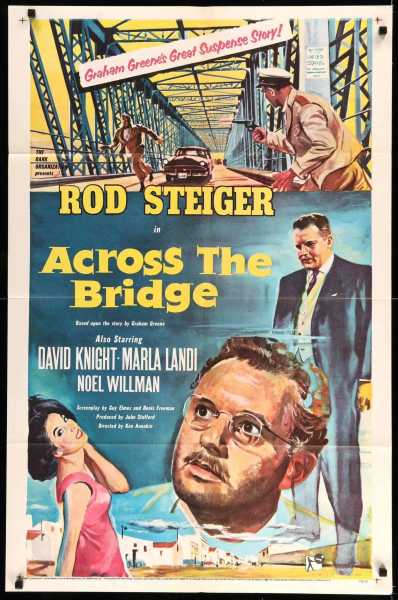
I’m not sure if Across the Bridge is a great movie. I’m pretty sure it’s not. It might just be a good movie, not a great one. Then again, maybe it’s a so-so movie, and I haven’t noticed it. In any case, it’s a great story, I tell you what. Crackling tale. Sometimes that’s enough.
It’s a British production from 1957. Most reviewers would tell you it’s in glorious black and white, or luminous black and white, or gorgeous black and white, or something similar. I’m sure the producer would tell you the same thing he told the director: It’s in inexpensive black and white. Simple storytelling doesn’t really need color anyway. Why pay for it?
If it’s in black and white, and it’s got a crime in it, many would call it film noir. It’s got plenty of crimes in it, committed by all sorts of people, and it’s in black and white, but there’s barely a hint of noir in it. It’s a British production, so they didn’t call movies that anyway. Brits would have called it a Crime Drama, or something similar.
Film Noir is of course a French term, but the style really didn’t originate there. It got a workout in Hollywood for nearly 20 years. They used the dearth of light and the ton of dark in the movies to add suspense, or a feeling of danger. In a way, the shadows themselves became characters in the movies.
That’s good, because a lot of noir films were pretty bad, and the characters weren’t very interesting. They needed the assist that moping around in the dark added to their mystique. With the lights on, you might notice Alan Ladd was only four feet tall, for instance.
Across the Bridge isn’t like that. Rod Steiger plays Carl Shaffner, a wealthy, abrasive jerk, who made his money the old fashioned way: Two sets of books. For some reason or another, Steiger plays him with a German accent. I guess in 1957 England, that was enough to identify villainy to the audience. Or maybe Steiger couldn’t be relied upon to sound British to a British audience, and they didn’t want him to sound American.
The original (short) story is by Graham Greene, who is a very sneaky writer. If you’ve ever read any of his books, they wander along, simply telling you what happened, and then every once in a while, the lull is broken by some memorable turn of phrase, or a trenchant insight into the human condition. There’s a reason fireworks always look best after dark. Another Graham Greene story that is more closely aligned with American noir sensibilities is The Third Man. Got a femme fatale and everything.
Across the Bridge is no The Third Man. It’s smaller in scope, although it travels from London to New York to Mexico. Greene was very familiar with Mexico, having lived there for a time, and his greatest work, probably, was The Power and the Glory about the Cristero War in Mexico. Of course being a British production, London was London, New York was London with some cardboard skyscrapers outside the set’s windows, and Mexico was Spain, because the airfare was cheaper.
The director was Ken Annakin. Workmanlike director. He had none of the moviemaking dazzle in his haversack that someone like Carol Reed brought to The Third Man. Extreme closeups and the occasional Dutch Angle were about it. Annakin was well-liked and hard working. His filmography could be labeled “value for money,” including one movie actually called Value for Money. He worked for Disney, who was definitely a value for money kinda guy. He never hired hacks, but no one got rich working for Mauswitz, except Walt. Annakin did Swiss Family Robinson for Disney in 1960. It was a big hit, and made a pile of money. It’s one of those movies the people who run the studio apologize for now, because the Asian pirates aren’t the heroes. Ho hum.
Across the Bridge has an expanded plot compared to the short story (duh), which includes more of a backstory for the main character. There is a fascinating byplay between the ostensible villain, played by Steiger, a Scotland Yard man sent to fetch him from Mexico, played by Bernard Lee, and the Mexican police chief, played superbly by Noel Willman. Both policemen are like the married man who is propositioned by a particularly fetching prostitute. He protests, “I’m happily married, and I don’t fool around. I will, however, hold still while you do.”
There are many reversals in the plot, but none of them feel forced. It’s interesting to note that every single person in the movie, more or less except one, is behaving badly the whole time. They are all trying to get what they want, no matter how sleazy or corrupt the methods they have to stoop to to get it. Everyone’s connivances come a cropper when the worst of them performs what is no doubt the only decent thing he’s ever done in his whole life, and wrecks it for everyone.
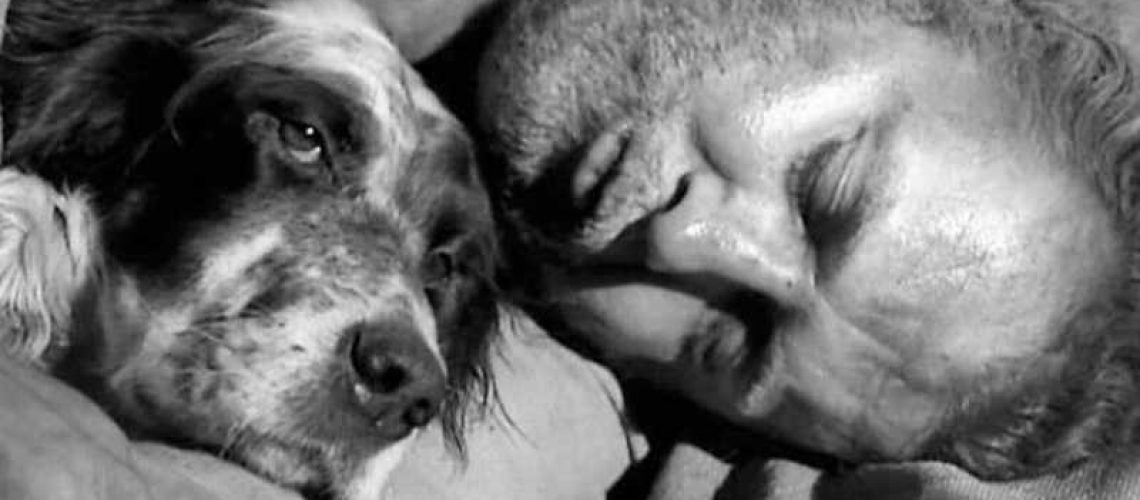
So I’m not sure if I can tell you that Across the Bridge is a great movie. I can report we watch it about once a year. We enjoy watching desperate people doing desperate things, while a bunch of people who think they’re honest forget what honesty is. We might watch it to see Dolores, the abused pooch with the sad eyes, as she teaches the human race a little lesson.
I’ll leave it to you to tell me if it’s any good. I guess it can’t be great, because instead of pasting a clip from the movie here, I’ll just paste the whole thing. If it was great, someone would still be trying to make a buck off it.
7 Responses
> The director was Ken Annakin.
There’s another one. From time to time, I stumble across a name or term from the past, and learn where some script writer, or producer, or author, got it. “Nestor”, a Cardassian court officer, from Star Trek DS9, was the mythologial Greek King of Pylos, for example. Now here’s some dude from the Skywalker family.
I couldn’t tell you whether I’ve read Greene. Probably, but not that one.
Hi Jed- When asked about, Lucas claimed it was a coincidence, but he must be the most derivative person who ever trod Hollywood earth, so I doubt it. Spelled it different, at least.
Haven’t read much Graham Green but his “Journey Without Maps” is a classic of travel literature. He and his cousin Barbara wander thru some sketchy neighborhoods in Liberia in the 1930’s. Just checked and it is still on my travel lit shelf, so I should read it again.
Hi SLM- I’m trying to picture some non-sketchy neighborhoods in Liberia in the 1930s, but I’m coming up blank.
I have read many of Graham Greene’s novels. Good reads. I don’t remember how many times I laughed while reading Travels with my Aunt, a comedy about taking an elderly aunt to Paraguay.
However, when it came to public affairs, Graham Greene had a talent for putting his foot in his mouth. In the 1930s, he wrote a salacious review about child star Shirley Temple in the magazine Night and Day. Twentieth Century Fox successfully sued for libel in England. As Pravda would have said, it was no accident that Greene went to Mexico. Shirley Temple scandal was real reason Graham Greene fled to Mexico. As a result of the libel lawsuit, Night and Day ceased publication.
In 1967, Greene wrote a letter to The Times of London. (Source: Norman Sherry’s The Life of Graham Greene 1955-1991. Volume III) He wrote that he would not be going to the Soviet Union to collect his royalties, because of its persecution of some writers.
Commendable.
To show that he was “even-handed,” he wrote:
To accentuate his desire to show that his attack on the Soviet Union’s mistreatment of writers did not mean he was against the Soviet Union as a whole, he added:
He wrote this while he was living on the French Riviera. Which indicated that Graham Greene’s political opinions were not to be taken seriously. He was a dilletante, a payaso (clown).
Which holds for the political opinions of many writers.
Looks like I forgot to check my blockquotes.
Hi Gringo- Fixed ’em for you. No extra charge.
Greene was like a lot of Britishers of his era. Joined the communist party when he was in college. Wised up (a little) when he got older. Like many of his contemporary writers, he often portrayed the United States as a pseudo villain. He seemed to like Americans, but distrusted the sort of efficient megastate the country became. Perhaps the USSR appealed to him somewhat as a scrappy underdog, which is comic in its way.
America isn’t portrayed as benevolent in The Power and the Glory, or the Quiet American, or even in Across the Bridge or The Third Man, where they’re portrayed as clownish and clumsy and out of their depth. Similarly, you could always count on Le Carre to find an American to dislike, even when the story is about soviets and britishers knocking heads.