

So there’s a city founded by the Spanish. It’s at the foothills of some mountains with a familiar name. The climate is dry, and lashed with dusty hot winds a lot. There’s a shortage of water. A couple of years ago, the reservoirs went dry, and water got rationed a bit. Once in a while, it rains way too much, and that causes flooding because the ground can’t take it all at once. And because of the peculiarities of the local rules about what you can do with your property, and the incendiary nature of the ground cover all around, the place is subjected to roaring wildfires that threaten whole neighborhoods.
Los Angeles? Nope. Monterrey, Mexico.
The similarity is quite striking, though, and recently, the news from Monterrey about their wildfires, and their response to them, is very instructive.
Firstly, if you’re a typical American, you probably figure Monterrey is just another John Wayne movie set, a hardscrabble pigpen of mud brick Alamos and cantinas in slumping shacks. I’ve never been to Monterrey, and probably never will go, but I was interested to learn that it’s more or less the richest city in Mexico. It looks it.
I’ve lived in Los Angeles. Monterrey is somewhat smaller than LA, but it ain’t small. There are over 5 million people in its metropolitan area. And to my eye, it makes LA look like a dump:
That’s another of our fave Mexican travel annoyers. You have to put up with the usual interludes of shoving eleventy kinds of food directly into the maw with a camera six inches away. We forgive everything because he flies his drone, and pokes all around. If you want to feel like a Bowery Boy urchin with your dirty nose pressed against the plate glass while the rich folks cavort inside, check out the malls in the video at around 8:30 mark.
While I’m in Mexico, I read the local paper online, and Mexico News Daily. Reading a newspaper in a foreign country is less annoying than at home, because you can’t immediately spot how they’re lying about their favorite political hobbyhorses. There’s a kind of chaste, spartan, just the facts style in many of the articles. These remind me of newspapers in the United States. You know, the ones you used to find back in the 1970s inside the houses of hoarders who had just died, but still had the papers from 1943 handy.
So today’s news from Monterrey was:
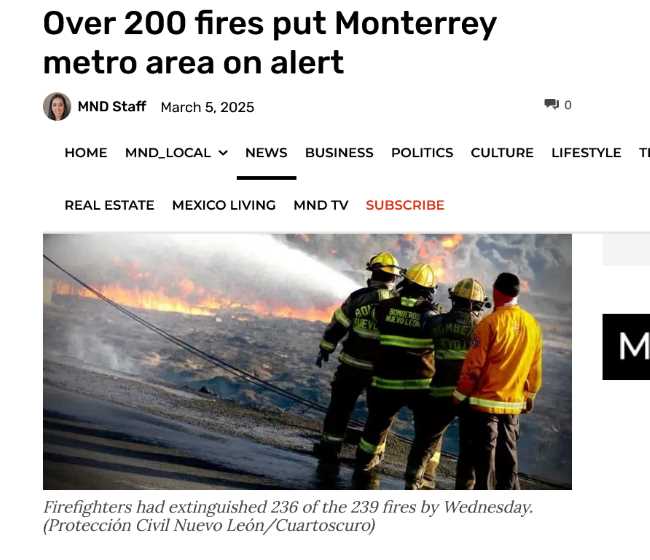
Of course I’m a proud, stubborn, and ill-educated Imperialist when it comes to weights and measures, so all their references to hectares sent me to the aspirin bottle instead of a reference website. IIRC, a hectare is about 2.5 acres. I don’t know how many hogsheads or hands on a horse that works out to. Anyway, many hectares are mentioned in the articulo, and there are over 200 fires going at once.
Why? Once again, this is going to ring a bell for Angelenos. It’s unusually dry, windy, and dusty right now, and some of the locals are irresponsible. Monterrey is smarter than LA, don’t get me wrong. The city requires that landowners clear their vacant areas from debris and vegetation that could make fires like these possible. Contrast that with the California version of land management, which is: touch one weed anywhere, you’re going to jail, even if those weeds are essentially gasoline masquerading as vegetation.
So how did Monterrey deal with the fires? They don’t say so, but I get the impression that the fire department and the local government didn’t tell everyone to stay home until they determined an exquisite ratio of wedding vegetables in the fire department’s pants, and ensured that enough lopsided blue hairdos were in attendance. They just sent out burly firemen in big fire trucks and put all the fires out by spraying water on them. I know, weird, huh?
I could also contrast their effectiveness to the fire departments in Maine. In Maine, people set their houses, and themselves occasionally, on fire with leaden regularity. They all report that they were just “freshening up the stove,” a euphemism for tossing a dixie cup of gasoline on their smoldering unseasoned firewood. The fire departments arrive, and stand on the snowy lawn until their “Save the Basement” strategy bears fruit.
Back to Monterrey. The local constabulary noticed that some landowners were trying to be cute, and instead of paying for their property to be cleaned up to forestall fire risk, they were practicing midnight oops dropped my cigar in this puddle of kerosene raids to take the cheap, burn my way to prosperity way out.
Once again, the contrast to approaches between LA and Monterey is noteworthy.
So far, 10 people have been arrested as suspects in some of the incidents. While authorities have not elaborated on what role these suspects might have played in the fires, Nuevo León does have a law — as do many municipalities and states in Mexico — requiring vacant lots to be cleared by certain legal deadlines. Noncompliant landowners can find their lots summarily cleared by the city and face a fine. As a result, it’s a commonly known practice across Mexico for landowners to cheaply comply with such laws by setting their lots on fire.
Hmm. Put out the fires. Arrest the miscreants. Get back to regular life. What a concept. If civilization ever catches on in California, they should try it.
9 Responses
You need to remember, im California, the view is “all those people need to be made to leave.”
You can visit and leave money, but move along.
They’re working hard at it, from what I can see.
Hi Ed- I guess that could refer to me. Left in the 80s.
IIRC, Monterey’s per capita income is twice that of Mexico. Monterey–the city of go-getters. There is a saying in Mexico that if there is anything happening in Mexico, someone from Monterey is involved in it.
Stereotypes exist because they are often accurate. For 8 years I had a next-door neighbor who was from Mexico. One time when I was talking with her, she made a remark about having to keep going, keep pushing, keep working hard. Reverting to the Monterey stereotype, I asked: “Are you from Monterey?” “Yes.” (Not all stereotypes are denigrating..)
Because Monterey has a semi-desert climate, it has few mosquitos. My neighbor from Monterey was continually complaining about the mosquitos, which were undoubtedly more common than in Monterey. I didn’t notice mosquitos here–maybe because I ate a lot of garlic. 🙂 Or because compared to a New England forest in the summer, mosquitos here are trivial.
Along with the deserved entrepreneurial reputation, people from Monterey have the reputation of being tightwads ( tacaño) . Tap your elbow-which means tightwad in Mexico. Which brings forth another connection. A fellow homeowner investigated his family tree, and found out that he had a 16th century Converso ancestor from Monterey. (Converso= convert to Christianity from Judaism.) A lot of Conversosended up in northern Mexico–as far from the reaches of the King and Church as possible but still being able to live in a Spanish-speaking area. New Mexico, for example.
Which leads me to suspect that some of the entrepreneurial tendencies in Monterey came from Conversos. As further support: any other groups with tightwad reputation?
At a funeral dinner last year, I met a Jewish woman who had been born and raised in Mexico. I mentioned to her my theory that the entrepreneurial tendencies and tightwad reputation of Monterey were related to Conversos ending up in Monterey. She thought it plausible.
On a visit to Monterey, I ate barbecued goat. Which is also big in South Texas (south of San Antonio).
Hi Gringo- I think maybe you tell better stories than me. I love: tacano, and tapping the elbow. Back where we’re from, we call it “alligator arms.” It’s sometimes accompanied by “Irish handcuffs.” That’s a pint in each hand.
Gringo, cabrito (goat) is popular in the whole of Texas south of Dallas, if you’re from here.
It’s kinda like Bohunks (czechs and such) with BBQ’ed coon. An out of body experience.
I enjoy reading your writing but noticed that I enjoy it when you go traveling even more.
Hi Robert- Many thanks. What the traveling affords me is grist for the mill. I run out at home.
Our lil’ ol’ company in Griffin, GA used to send a lot of substation hardware to equipment manufacturers in Monterrey. I guess we were approved to supply before US, Canadian, and US firms moved their switch, breaker, and transformer plants there…….
*European