

So, everyone says they want a house, but they can’t afford one. Various explanations for this unaffordability are proffered. Interest rates are higher than they were for a short period a few years ago. That isn’t helping, although anyone who lived through the 1980s would snicker at you if you mentioned it. Wages haven’t kept up with inflation very well. But in general, what I hear, no matter what is being said about the topic, is that everyone thinks they should be able to live exactly where they prefer, and the houses should be cheap there. Uh-huh.
Good luck with that. I’d like to roll a different ball out onto the field. If you’re modestly intrepid, you can find a house for a relative pittance and live in it while you fix it. Then sell it, take the dough, and live where you want, or maybe do it more than once if you’re young and nimble. I’m living proof that it can be done. All you have to do is adjust your way of thinking about owning a home.
Everyone from realtors to talking heads on teevee refer to a home as “an investment.” It isn’t, at least in the way they’re blabbing about a roof over your head. A home is an expense. It may or may not be worth the money you spend on it, but it’s not an investment. For the most part, all the money you’ll gain if your house rises in value is just inflation rearing its actuarial head. Money is worth less, so the house eventually sells for more. You’re going to have to have an amazing nose for real estate to find a place where property goes from worthless to expensive without relying on inflation. You could have bought some bombed out property in many places in New York City back in the early 80s, and made a killing on it later. However, you’d also have to avoid someone making a killing on you in the interim, in a more direct way.
So, you’ll get no advice to buy rock-bottom real estate in murder capitals from me. But you can still find interesting and potentially valuable houses out in the sticks. And you can turn them into real investments, if you turn them into a part time job for yourself. I did it recently, and made a 900-percent profit on the deal. Tax-free, too, because as long as you live in it for at least two years before you sell it, you can make $250,000 before capital gains taxes kick in. Or $500,000, if you’re married, which I highly recommend. One of you can make peanut butter sandwiches while the other holds up the kitchen floor with a post jammed under the floor beams.
How about an example, Sippican? Sure thing.
Here’s a little number in Sangerville, Maine, that you can pick up for around $50,000:
Someone already thought they could make a killing with no effort on this place. They bought it four years ago for fifty grand, never touched it, and the town took it away from them this year because the house was unlocked and unattended, and they never paid their taxes on it.

It’s a 2,500 square foot, 5-bedroom, 2-bath Shingle Style wonder. Big old barn, too,
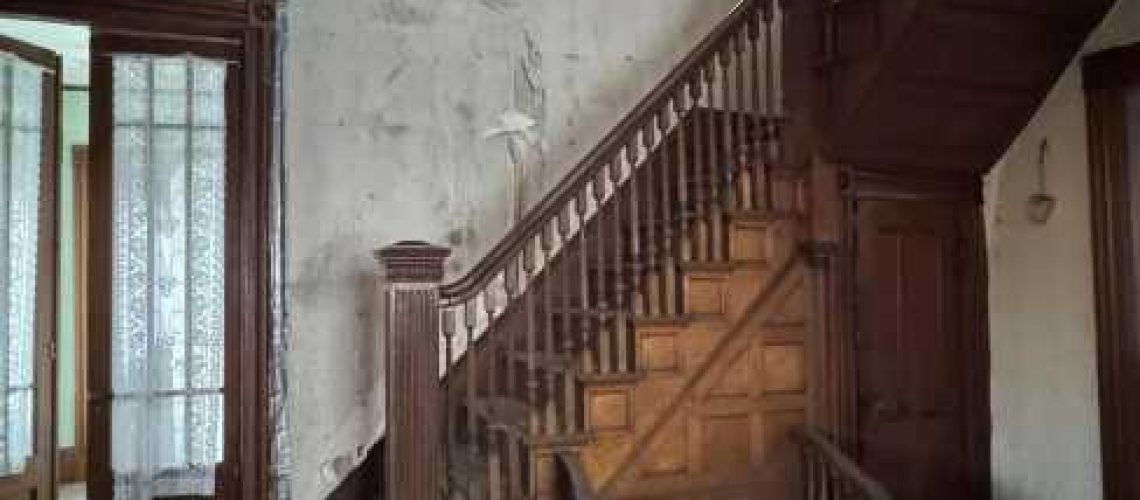
It needs some serious work, but so what? The more work it needs, the more money it will bring when you’re done. Unlike a lot of houses this age, the entire fabric of the place hasn’t been defaced with vinyl siding and gray plastic floors. Viz:

Sand the floor, replace the wallpaper, and put a fresh coat of clear on the wood work and you’ll be dining in style in no time.

The kitchen and baths won’t make it into Architectural Digest or anything, but so what? I’ve seen people ripping out ten-year old kitchens because they watched Better Homes Than Yours on teevee and noticed that everyone had quartz countertops instead of granite. Might as well plan on replacing everything in there. But I’ll bet those appliances still work. You can use them while you’re banging on the place.

Everyone is looking at this sort of project with the wrong idea. House flippers would love to wreck this place in their inimitable gray everything style, but the numbers won’t work. Not many people want to move to Sangerville, Maine from places where the trolleys run. It’s a tiny town in unfashionable Piscataquis County. You’ll have to be your own first customer. Buy it from yourself, as it were. When you’re done working on it, you can sell it to someone else in Sangerville whose house is still a mess, and doesn’t want to put in the work. Banks will lend them the money to give you a big return on your sweat and purple thumbs.
The smartest way to look at a house like this is to add up what it would cost to produce the same mess you see in the pictures. You’d have to find a 3/4 acre lot, then get town water and town sewer and electrical service to the place, and basically build a half-million dollar, partially completed structure to get the same value. Taxes? A hundred bucks a month. Crime? Well, there really isn’t any anywhere in Maine. If you’re willing to live in any city in the US, this place should hold no terrors for you.
There’s nothing to do in Sangerville. On Yelp!, the first two things to do and see are a farm stand, and sled dog excursions. The town’s only claim to fame is that the man who invented the machine gun once lived there. But then again, why would you need something to do in Sangerfield? Your house will be the biggest something to do in Sangerfield. If you need a hobby, you can stop trying to fix the wallpaper in the living room and fix the floor in this room for a change of pace:

So, you want a house. Sangerville is over there. It’s only a matter of going.
5 Responses
If I had to buy something like that house, I’m pretty sure the first thing I’d buy would be a big RV in which to live while I tore its inside out. The second thing I’d do would be to rent a humongous dumpster in which to put all of the moldy, rotted, fungus-infested, and busted wood, plywood, sheetrock, plaster and other miscellaneous junk in. Might take two or three of them.
Trying to live in a place like that while you’re working on it is terrible. I know you’ve done it (I’ve seen the pictures) but I’d never be able to handle it. I’d just want somewhere I could go at the end of a 16-hour-day to clean up, eat, and collapse where I didn’t have to worry about something collapsing on me.
Then tighten up the perimeter…roof, walls, windows, doors. Insulate. Re-wire, and re-plumb if necessary. Then get the kitchen and at least one bathroom working, and then you can maybe move in. You can leave cosmetics (trivial stuff like drywall and flooring) until later.
Having gone through the realtor’s terrible pictures, I gotta ask, what the heck is that big black square on the floor in front of one of the fireplaces? It’s got some weird thing (conduit?) sticking out of the floor like a nasty metal snake waiting to strike the unwary, but I can’t identify what the heck that whole thing used to be. A hot tub? In front of the fireplace? Enquiring (i.e., nosy) minds want to know.
Hi Blackwing- That’s probably a pellet stove exhaust. They took the pellet stove with them.
It’s not so much can’t afford a house, it’s can’t afford a lifestyle.
If you’re willing to live under a bridge it’s all much simpler.
That’s why SoCal is the destination for the homeless lifestyle. No HVAC bill.
Living in a house in rehab mode is quite feasible. It’s not as bad as some think. The house my parents bought when I was 3 years old was occupied and thus livable when they bought it, unlike the house featured here. You could live comfortably in the house without doing a thing to it.
But my father wanted better. Most of the rehab took 12 years. A room–a project– at a time. The kitchen cabinets that my father and grandfather built, which took a month?, were probably the most egregious example of “camping out” while rehabbing. Though installing fireplaces in the kitchen-dining room and upstairs several years later could also be put in that category. A room at a time…
A decade later, my mother’s stepfather gifted us a dishwasher, which resulted in some more kitchen work, including a more cabinet work.
But if the house isn’t initially livable, a RV or a house trailer is a good approach.
I considered buying land out in the country here in TX, digging out a basement to survive the summers, and topping the basement w a house trailer. Hay bales w stucco around the trailer for more summer survival. But that would have entailed a big commute, which I decided was the killer.
The house featured here looks in fairly good condition. But like you say, what are you going to do in Sangerville ME?
I did a gut rehab while living in the house. Created a temporary kitchen in the basement. Rigged up a shower surrounded by tarps on the back patio. It’s doable. But every day you have seal the other room doors with tape and finish the day with a shop vac else the plaster/framing/trim work dust will drive you crazy. Also, living in Bumf*ck, Anywhere would drive me crazy.