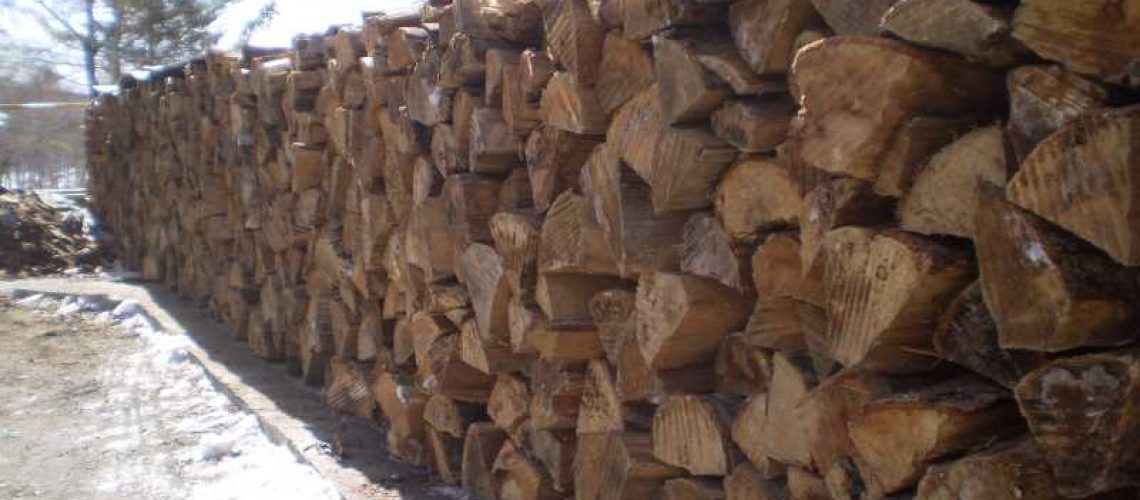

You’d think people in Maine would know something about firewood. You’d think wrong.
I certainly assumed that the topic of felling, sawing, splitting, and drying firewood would have been pretty much settled around here by the time the Indians stopped giving impromptu haircuts to the newly arrived locals. No such luck. No one in Maine seems to have any idea how to dry firewood properly, or burn it without setting their digs on fire. I found this out the hard way.
If you’ve ever read the US Army Survival Manual, you might remember a chapter or two about what to do if you’re stranded in some strange, faraway place, and need to survive in an alien landscape. Surprisingly, even though it’s the army, they don’t advise you to kill all the locals you find. They instruct you to observe them closely instead, and do as they do to survive. I guess they figure that after you get the lay of the land, you can always kill them later. Now, I’m a pacific sort of person, and don’t want to kill anyone except cold callers at 5PM, but after watching the locals handle firewood for a while, I knew that any violence would be superfluous anyway. They were all busy trying to burn down their own houses while they were still inside, instead of the normal way, with an alibi, to collect the insurance.
About 75% of the population of Maine are volunteer firemen, I think. They have a sensible “save the basement” approach to house fires here. They’ll mill about on your lawn with you and commiserate over your misfortune, and they eventually get the cellar hole to stop smoldering, but other than that, you’re on your own. I think they realize there’s no point in rushing into a burning building in Maine just to extinguish a wood stove fire. They’ll just be back again in a week or two when the resident, still wearing bandages from the first go-round, sets himself and his digs afire again. He’ll explain that he has no idea what caused the blaze, all he did was “freshen up the stove.”
If you’re unfamiliar with that term, it means he threw a cup of gasoline on the smoldering pile of green firewood he’d been trying to burn for a few hours with no luck. The firemen nod and smile, because they’ve all done it too. No one in Maine has dry firewood. No. One.
Don’t get me wrong, they all think they have dry firewood. Hell, they even sell it, and advertise it, and call it that. There must be an encyclopedia of methods to dry firewood in some library in Maine, a ten-volume set of wive’s tales and urban legends that everyone checks out and then has a go at. They’ll try anything except something that works.
So we’d managed to install a woodburning furnace, but like a young couple that gets the baby before the bassinet, we didn’t have much to burn in it. I was still making beaucoup furniture back then, so I had some very expensive fires to pass the time. You don’t know what profligacy really is until you burn tiger maple and quarter-sawn oak in your furnace for heat. It’s like making omelettes with Faberge eggs.
The internet in Maine ain’t like it is in civilization. People still advertise in the local shopper coupon circular, and not much else. A few brave souls venture onto Craigslist to advertise stump grinding, tree work, and cellar hole cleanups after fires. They’re all terrified that someone will take advantage of them, so they spell out their phone numbers phonetically. It’s the internet version of hiding your wallet in your shoe at the beach when you go swimming. No one has a working website. They all have four abandoned directory listings that their cousin, who’s good with computers, set up for them, and then immediately lost the password. None of them has the right phone number.
So I scoured the snowy earth in the old-fashioned way looking for firewood. I actually read the business cards stuck under the plastic sheet on the counter next to the register in the hardware store. I asked everyone if they knew a guy who knew a guy who knew a guy. And I was rebuffed with extreme prejudice, and deservedly so, truth be told. To them, I was just another carpetbagger from another state that didn’t follow along with the local playbook. You get your firewood in the spring and summer, and burn it in the winter. Asking a guy that switched over to plowing driveways four months ago to shovel out a woodpile and deliver it is a bit of an imposition. Mea culpa.
I offered to pay nearly anything to anyone who would listen, but they’d all sold out months before. But after a while, I started to encounter folks who would still deliver firewood. And we’d begin the dance.
“Is the firewood seasoned?”
“Absolutely.”
“How long was it seasoned?”
“A year.”
“It was cut and split a year ago?”
“No. We stack the logs in the yard for a year, and split them when someone orders some.”
“But logs don’t dry just by leaving them out in the yard.”
“Sure they do. Besides, if they give you any trouble, you can always freshen up your stove.”
We finally gave up and stopped asking for seasoned firewood. Whatever we got would be wetter than a porpoise’s purse anyway. Just bring what you’ve got.
“Do you have a cord?”
“What kind of cord?”
“There are kinds?”
“We got face cords and loose thrown cords.”
“What’s a loose thrown cord?”
“Two-hundred-and-fifty dollars.”
“That’s not what I meant. What is it?”
“It’s firewood.”
“Oh god, just bring it.”
And here’s a loose thrown cord of “seasoned” firewood:
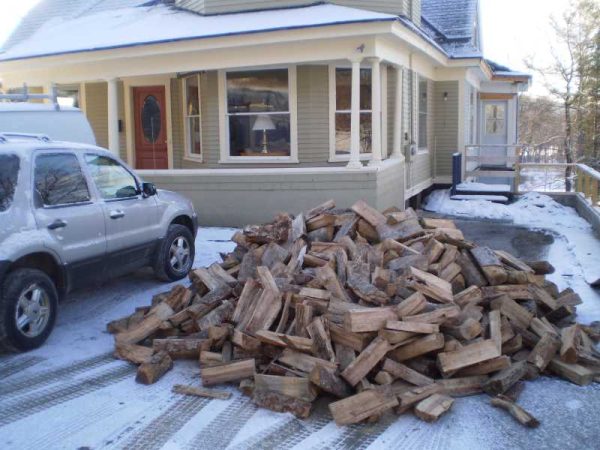
I know a loose thrown cord sounds like a linebacker’s knee injury, but it’s an actual thing here in Maine. The Department of Weights and Measures pretends it’s not just a heap of wood in the mud, and has a definition for it:
B. Loose Thrown Cord
Maine law also defines a loose thrown cord as: “Fuel wood, when sold loose and not ranked and well stowed, shall be sold by the cubic foot or loose cord, unless other arrangements are made between the buyer and seller. When sold by the loose cord, the wood in any cord shall average either 12 inches, 16 inches, or 24 inches in length. When so sold, the volume of the cord shall be: a cord of wood 12 to 16 inches in length shall mean the amount of wood, bark and air contained in a space of 180 cubic feet; and a cord of wood 24 inches in length shall mean the amount of wood, bark and air contained in a space of 195 cubic feet.”
So, a heap of wood. Many wood sellers “season” their wood by leaving it in loose thrown cords like the picture. It’s better than leaving it as logs, but I can assure you that firewood piled like this will not dry properly. The center of the pile will be mulch before the top dries out. But hey, I’m the Out-of-Towner, what do I know? And it’s supposed to add up to 128 cubic feet if you stack it. Pull the other one, it has bells on.
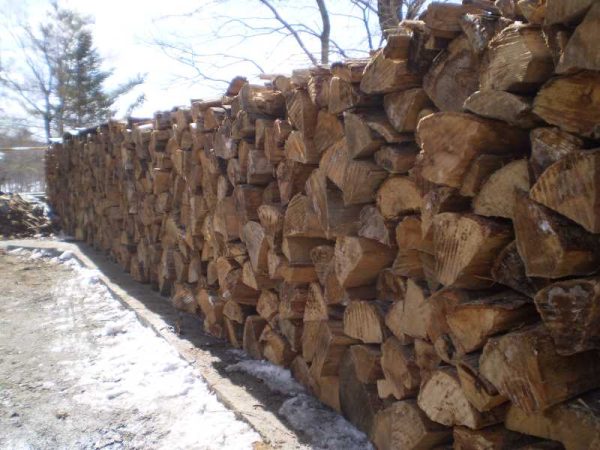
I pulled out a moisture meter and tested a piece of firewood. By definition, seasoned firewood is seasoned when it adjusts its internal moisture content to the moisture content of the air around it. In the winter around here, that means maybe 20%. My moisture meter didn’t give me a number, it gave me a warning message not to submerge this delicate instrument under water any more.
We’d have to burn it, or shiver until spring. But I’d be damned if I’d do it by freshening up the stove every day. Gasoline costs too damn much.
[To be continued]
3 Responses
There are times I feel blessed to be in Wyoming. Back in Minnesnowta you could take down a tree, cut it up into 16″ logs, split them, and then stack them between two live trees. In six months the bottom layer of wood has sunk half into the ground, mostly rotted, while the upper layers are just starting to crack and check, indicating that they might be drying out. After a summer of monsoon rains and horrific humidity even the top layer is starting to rot. About the only way to season wood there is in a dedicated building with a dehumidifier.
Here in Wyoming you cut down a tree, cut the trunk to length, and then stack the wood. After a few months it’s cracked and checked like an unstable tectonic plate, and a couple of touches with a splitting maul makes the pieces jump apart. You stack the cut and now-split wood in your racks (or on the ground, or next to your unused RV) and it dries out to where the ATFE should classify it as explosive material. Toss it into your wood stove with the damper open and an entire cord will be gone in two days, burning at 10,000°F and leaving no trace of its existence except for the pile of ash down below.
But your wet towels dry out quickly leaving no trace of the mold and mildew they’d get in MN, so there’s that, too.
OK, so you find a way to compact the old used tires and then periodically fetch the wire out along with the ashes upon converting to BTU’s, baby!
Motto of the local volunteer FD down here in GA: “We never lost a chimbly”