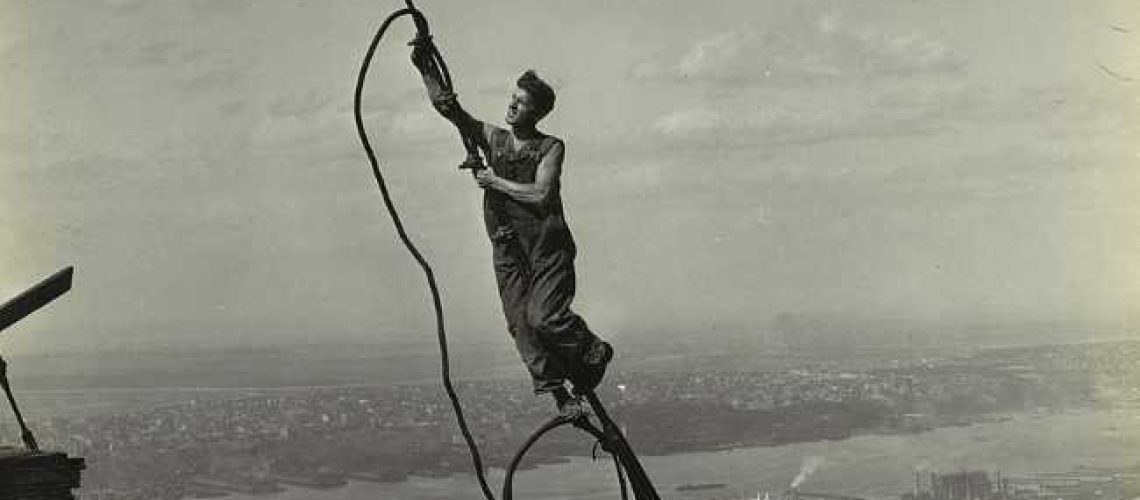

This video might be interesting to any number of people from most any walk of like. It’s like catnip to anyone who ever constructed a commercial building. I think it’s the greatest example of construction, ever. You can build things taller, or wider, or goofier (I’m looking at you, Gehry), or more expensive, or more elaborate, but you can’t ever surpass what was accomplished by so few men in so short a time, resulting in a more iconic building. The Empire State Building in New York City is the greatest office building in the world, and has been since the day it opened.
The lady out in the harbor with the lantern jaw, wearing a bathrobe, holding an ice cream cone, and beckoning every country on Earth to use America as their recycling bin has nothing on the Empire State Building. I wouldn’t be surprised if half the population think the Empire State is named after the building, not the other way around. The only structure as iconic as the Empire State Building might be the Eiffel Tower, and that’s nothing but a radio antenna, when you really look at it. Big deal.
The Empire State was completed during the Depression. They didn’t have trouble finding people willing to take risks to earn a living just then. So you’d be forgiven if you assumed that they’d look at workers as kind of expendable. You assumed wrong, however. Up to 3,500 people worked on the building at any one time. Four people died during construction. That’s 3,500 people working two shifts, day and night, to complete the tallest building in the world in one year and 45 days. Four deaths.
Let’s compare that to the World Trade Center Project in 2001. One World Trade Center, which is as ugly as a home-made suit, took 8 years to build. It had somewhere between 4,000 to 5,000 workers, and depending on who you ask, had 5 worker deaths. If you do the math, the fatality rate per worker is essentially identical to the Empire State Building. Other big buildings like the Burj Khalifa and the Shanghai tower claim lower fatality rates, but I don’t trust stats about worker safety from closed societies, thank you very much.
So you can see the guys in the video working on the Empire, hanging all over it like King Kong would a few years later. They didn’t fall off much. They didn’t have OSHA, or any number of other safety foofaraws that are in place today. So how did they manage to stay in one piece while working four times as hard as people would in the future?
It’s simple, really. They were smarter than people are now. Not the kind of smarter that’s in vogue nowadays. None of them was plucked from any Ivy League admission offices. They were predominately Irish and Italian immigrants, at least from what I’ve read. They had nerve. They had skills. Mad skills, by the look of it. They had experience building things like railroads, mining ore, or erecting steelwork, even if it was a little closer to mother earth. Many were craftsmen, with prodigious hand skills developed by long experience. They were used to working around heavy machinery and keeping their fingers out of the gears.
By comparison, modern workers are skilled at avoiding risk, instead of managing it. They’re more conversant with technology-driven tasks. They crave automation, standardized working conditions, and lunchtime. They’re not really skilled in navigating dangerous situations in the way their predecessors were. But they died at the same rate, because building great big things is inherently dangerous, and having little experience with true danger make them vulnerable to brain farts, as we used to call them.
The Empire State Building was constructed in a truly high-risk, high-reward milieu. Men with a high tolerance for risk, or whose desperation for work overrode their tolerances, needed mental toughness, and relied on their experience in risky environments to stay safe. Modern workers rely on a rulebook that only the shop steward has read. The investors, who didn’t stick one spud into a rivet hole, were also working in a high-risk, high-reward mode. The building didn’t start to turn a profit until the 1950s.
We could use a few guys like the men who financed and built the Empire State Building just now. God knows where we’re going to find them.
7 Responses
Looking at the portions devoted to the girder design, you can understand why the bloody thing stayed up even after being hit by a (relatively small by today’s standards) B-25 bomber that ran into it in the fog. It killed the 3 people in the plane and 11 people in the building, and started a fire, but the durned thing was open for business 48 hours later.
I’ve seen photos of people working on the radio antennae on the top of the dirigible mast, and quite frankly if I think about what I’m looking at it can make me slightly ill. You’d never get me up on those girders like one of Tull’s “Steel Monkey’s”. Nope, nope, noppity nope-nope-nope. Can you imagine what would happen if you just sort of reflexively stretch just a little too far when somebody bucks you a hot rivet just out of reach?
Hi Blackwing- When we did steel erections (much lower to the ground, but still), all the crews were Mohawk Indians. They were all completely blase about working at any height. I was nervous as hell just supervising them.
I used to work off ladders and staging and stuff. Anything over about 40 feet or so makes you think about lighting candles in the nearest church.
Anytime you’re working on a job and you see pigeons flying below you, is not a good day. My brother used to hang signs, and he had one sign on top of the building, and he hated working there. However, he said the worst place for them to work was one neighborhood where the spiteful mutants in the neighborhood would try to steal his ladder while he was up in the air
I was on an oil tanker once and one day we were at anchor offshore someplace and I woke up in the morning and saw another ship at anchor nearby and it was a sister ship of ours and I talked to one of my shipmates and mentioned how it was identical to us and they guy I was talking to corrected me and he said no. If you look at the aft house. There is a steel wall around the quarter that was put in place because there was a fire in it that caused an explosion, which killed people in the sleeping quarters. Then he said You see the pump house and I said Yes he said. Notice how there is another door in the front. Our pump house doesn’t have that door. Now, do you want to know why they have a door?? That’s because once there was an accident and the steam line broke. There was no way to get out, and so the people got steamed to death. And I asked him Well, how come we don’t have the door on our pump house or an extra wall to protect from an explosion, and he said that was because nobody’s gotten killed on our ship yet.
When I got hired to work in chemistry, manufacturing in 1980, the lady in human resources asked me if I was squeamish about working with blood, and I said no and I ended up every Monday having to cut open several thousand plasma bags until I got blisters on my fingers to drain the plasma and process them in a big 2000 L tank. About a month later, the AIDS epidemic started. About six months later, I would’ve traded my job to one where I worked on girders on tall buildings in a heartbeat.
Don’t remember the details or exact stats but saw something once while visiting San Francisco. Construction of the Golden Gate Bridge was considered extremely dangerous, and they had several workers fall to their deaths into the channel, so they built a giant net underneath the structure to catch future fallers. No one fell afterwards … coincidence or ‘safety net’ replacing fear?
Climbed steel in 80’s on microwave towers back when there was such a thing. No Empire State level of achievement, was interesting tho. Few times I walked a beam untethered. Still alive and I wont try to duplicate that.
From what I just read, only two deaths during the construction of the Empire State were falls, which is the thing that gives us the biggest willies about such construction.
One struck by a truck
One struck by a hoist
One killed by explosives
Fall down an elevator shaft
Fall from scaffolding
Those last two falls could just as easily have been 50 foot falls as 800 foot falls.