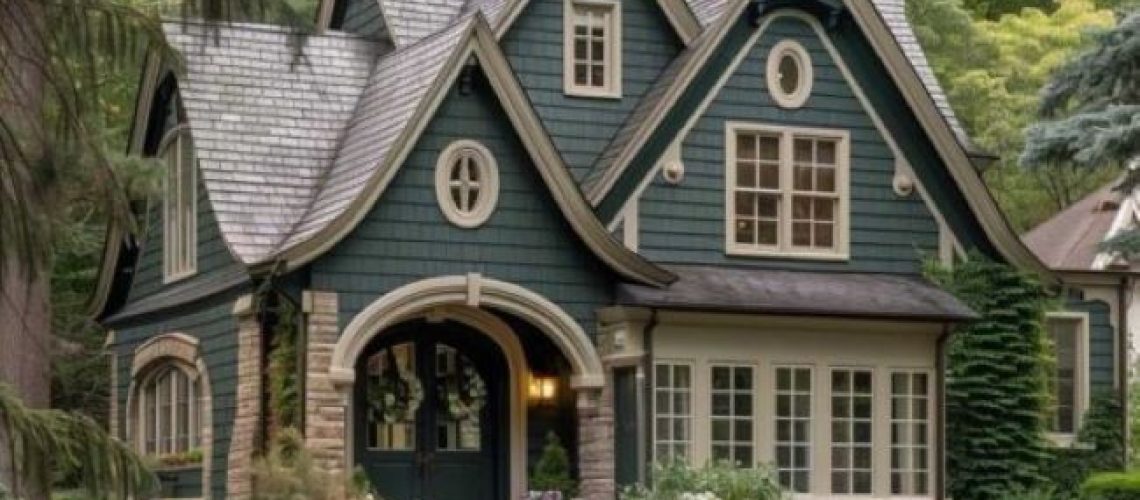


I encountered this image on some far-flung Gymnst page. It didn’t have any notes or links associated with it, so I can’t credit it to anyone. It was labeled, simply: A Beautiful Home.
It may well be. The correct-er term for it would be a beautiful house. The noun “home” indicates something about the occupants. It could be peopled with Jack the Ripper devotees for all we know. But I doubt it. I’d have a hard time believing the denizens aren’t salubrious. By their works you shall know them, and all that.
So we’ll play it as it lays. It’s a beautiful home. Why is that?
It’s Saturday, so I’m going to give you folks the day off. I’ll answer the question. You rest. We’ll use only the information at hand, i.e., just what you see. It’s entirely possible the interior is a gray-walled, gray-floored, barn-door, modern farmhouse abomination. But I doubt that. It’s unlikely anyone who went for this style on the exterior would flip the HGTV switch and go full retard inside. So we won’t assume any facts not in evidence, your honor.
Why this house is beautiful:
Human scale:
The proportions of the entire house, and the dimensions of the components that make up the house, are based on human beings. The windows are divided into panes about the size of a person’s face, for instance. It’s a big house, but it looks like a normal family could live in it and not need walkie talkies to find each other. The wood siding is coursed in rows about the width of a man’s hand. They wanted a big entry, but they split it into two modest sized doors, instead of a big, silly one. The place looks like it was designed by and for regular human people.
Visible head:
In symmetrical architectural styles like Adam colonials, the door is located in the center of the facade, and windows are placed in identical places to their left and right. The front of the house basically becomes a head with a face. People instinctively know how to approach a house with a visible face as a cue. When the Victorians got rolling, they shifted the symmetrical rectangle idea to make a version of a pinwheel. The houses still had a face, but it was smirking. An off-center head is still a head, and this house immediately lets you know where to go and what to do when you get there. Snout house need not apply.
Proportion:
This is related to the scale of the thing. The house is massed in interesting blocks, and has a very complicated roofline. But nothing much is exaggerated. Nothing is clownish. You can kinda guess what’s going on in each part of the house by the general size of the and shape of the parts.
Color:
The colors of the house are taken from nature, and not just nature, but the local version of nature. Nothing is garish. The roof relates to the sidewalls which relates to the trim with relates to the stone which relates to the setting.
Landscaping:
Good landscaping is getting pretty rare. Houses, hardscapes, and plantings look like they’re at war with the earth. Earlier builders understood that a house could look like a scar on the land. Alien. So landscaping was used to properly soften the join between the structure and the ground. This house does it very well. There’s a gentle transition from the earth to the house, and pots on the stairs and the plants creeping up the walls blur the difference between hardscape and landscape and the house itself.
Texture:
The stonework is coursed ashlar or something similar. It’s gathered into straight buttresses and bands along the foundation line, but still displays a variegated texture that lends interest. The shingled walls look like shakes in the picture. The roof looks like individual pieces lying side by side with their neighbors, not a monolithic sheet of stuff.
Rhythm:
The windows are ganged into rows instead of big, gaping sheets of glass. The walk is flagstone that repeats itself in a jazz motif. The steps have a tempo. The house is composed, not just put together.
Style:
This doesn’t look like an old house to me. It’s a revival of a revival, I’ll bet. Perhaps it’s a Richardson Romanesque Revival Revival. It’s got steeply pitched gable roofs, stone banding, stone buttresses, stone chimneys, a jerkinhead roof, and rounded arches here and there.
There are rules to building in a style like this. The designer used the rules in an original way, and delivered something that strangers on the intertunnel would call beautiful.
Things have changed. Designers now start with the idea that there shouldn’t be any rules, so they can do anything they want. That’s why most everything built in the last thirty years or so is an abomination. And the only original things about a house are the way each one is worse than the last one. Oh well. I hope you can find a beautiful house of your own. Or maybe make one out of a not-so beautiful one. I’ve tried that a bit, and it’s funner.
3 Responses
whimsical
First off I can’t believe you had no snark so I’ll have to do say it….. as a former roofer I have a huge problem with how those gable roofs tie into each other. It looks like this house was put together by advanced Craftsman. I’m sure there’s some people around who can still do those those curvy roofs, curvy doors, curvy windows. I just haven’t met them lately. If they can find that good a craftsman I’m sure they can find someone who knows how to roof valleys between two adjacent gable roofs.
Having said that yes. yes. Yes. YEs. YES. did I say yes enough?
It is a very lovely lovely house. All of your observations were astute and on point.
I’d be willing to bet that if they put that much effort into the exterior that the interior is pretty nice, too. I’d even be willing to bet it’s an actual wood-burning fireplace, and very probably some built-in bookshelves since I simply cannot imagine somebody who built a house that looks like this that doesn’t read.
Our old 1,100 square foot 1901 farmhouse was literally covered in bookcases on every wall and flat surface by the time we left it, most of them relatively primitive since they were built by me. Our current house you might deride as a “snout-house” since the garage is attached, but it’s on the northwest corner of the house facing north, so it’s a wonderful airlock during blizzard season here in NW Wyoming. One of its main features for us was a partially-finished basement which is now a library in which I can finally have almost all of my books, both hard-cover and paperback, arranged by author instead of spread out through different places in the house. My wife has her painting area in the middle of all that.